Secure Human Review Workflows for Sensitive LLM Outputs: A Compliance Guide
 Apr, 15 2026
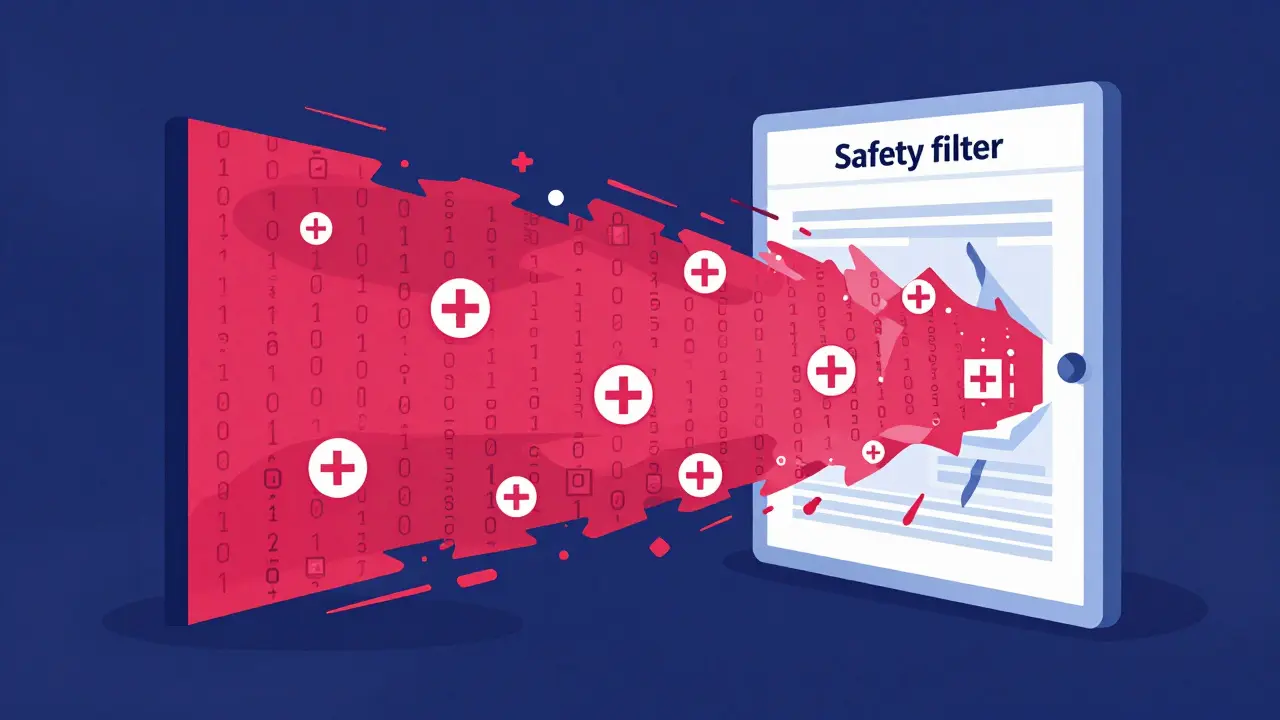
Imagine a healthcare provider using a cutting-edge AI to summarize patient notes. It seems efficient until the model accidentally leaks protected health information through a subtle pattern it memorized during training. This isn't a hypothetical nightmare; it happened in March 2024, resulting in a $2.3 million GDPR fine. When you're dealing with regulated data, relying solely on an AI's "safety filter" is like using a screen door to stop a flood. You need a human in the loop.
For companies in finance, healthcare, or legal services, human review workflows are no longer a "nice-to-have" feature-they are a survival requirement. These workflows are systematic processes where trained people validate and approve AI-generated content before it ever reaches a customer. According to AWS, these checkpoints can slash sensitive data exposure incidents by 87% compared to fully automated systems. If you're operating in a regulated space, skipping this step is essentially playing Russian roulette with your corporate data.
The Core Components of a Secure Review System
Building a secure review process isn't just about having someone read the text. It requires a rigid technical infrastructure to ensure the reviewers themselves don't become a security vulnerability. The first line of defense is a robust Role-Based Access Control (or RBAC), which is a system that restricts system access to authorized users based on their specific job role. To keep things tight, most enterprise frameworks now mandate four distinct permission tiers: reviewers, approvers, auditors, and administrators, all protected by multi-factor authentication.
Beyond access, the environment where the review happens must be locked down. This means using encrypted interfaces-typically AES-256 encryption-to prevent "shoulder surfing" or data interception. You also need a version-controlled audit trail. If a regulator knocks on your door three years from now, you need to show exactly who approved a piece of content, when they did it, and why. For those in the financial sector, SEC Rule 17a-4(f) requires these records to be kept for at least seven years.
Designing the Three-Stage Validation Pipeline
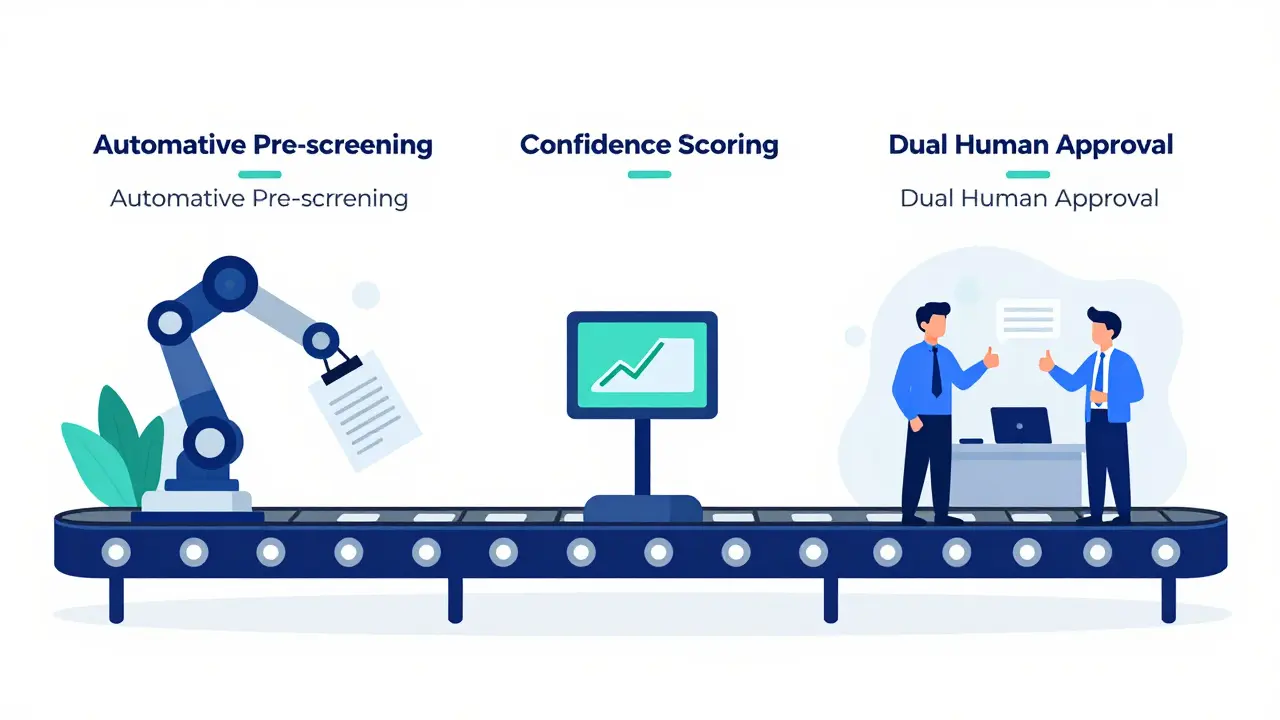
You can't send every single AI output to a human; you'd grind your business to a halt. Instead, a high-performing workflow uses a tiered funnel to identify high-risk content. This process usually follows three distinct stages:
- Automated Pre-screening: The system uses keyword blocking and sentiment analysis to catch obvious red flags immediately.
- Confidence Scoring: The LLM assigns a certainty score to its output. If the confidence falls below a specific threshold-often 92% in enterprise settings-the content is automatically routed to a human.
- Final Human Approval: For high-risk categories (like PII or financial advice), the system requires dual authorization, meaning two separate people must sign off before the content is deployed.
While this adds a bit of latency-usually between 8 and 12 seconds per cycle-the payoff is massive. Combined with automated filters, this hybrid approach reaches nearly 99.98% accuracy in catching prohibited content.
| Approach | Detection Accuracy | Speed/Throughput | Cost | Best For |
|---|---|---|---|---|
| Fully Automated | ~63% | Instant | Low | Low-risk marketing |
| Hybrid (Human-AI) | ~94% | Slower (8-12s delay) | Moderate | Regulated industries |
| Manual Only | High (variable) | Very Slow | Very High | Ultra-sensitive legal docs |
Navigating the Trade-offs: Custom vs. Turnkey
When it comes to implementation, you'll likely choose between a commercial platform like Superblocks or building something custom using a framework like Kinde. Superblocks provides a turnkey solution with built-in audit trails and RBAC, which is great for getting up and running quickly. However, it can be pricey and offers less flexibility for niche requirements.
On the other hand, custom-built workflows using open-source guardrails give you total control over the logic. The downside? It takes significantly longer to deploy-usually 12 to 16 weeks of development time. For many, the hybrid approach is the sweet spot: using a commercial tool for the "plumbing" (auth and audits) while customizing the review logic to fit their specific industry needs.
The Human Element: Combating Fatigue and Bias
The biggest weakness in any secure workflow isn't the software-it's the person. "Reviewer fatigue" is a real phenomenon where accuracy drops by 18-22% after just 90 minutes of continuous work. If your team is staring at AI outputs for eight hours a day, they'll start missing things. To combat this, follow the MIT guidelines: limit review sessions to a maximum of 60 minutes, then mandate a break.
Then there's the issue of bias. As seen in some banking implementations, reviewers might subconsciously skew approval decisions based on their own assumptions rather than the provided criteria. This is why continuous training is non-negotiable. The NIST AI Risk Management Framework suggests a minimum of 16 hours of specialized training for reviewers to recognize subtle hallucination patterns that a casual reader would miss.

Real-World Success and Failure
When done right, these workflows are a superpower. JPMorgan Chase managed to process nearly 15 million sensitive financial queries in late 2024 with zero data leakage incidents. Similarly, Capital One reported a 91% reduction in PCI compliance violations after implementing human checkpoints in their customer service bots. They didn't just add a person; they added a process.
But a failure to train is just as dangerous as having no process at all. In Q3 2024, a major healthcare provider suffered a massive breach where 2,300 patient records were improperly approved for external sharing. The problem wasn't the software; it was that the reviewers hadn't been trained to spot the specific types of sensitive data the LLM was leaking. It's a stark reminder that a human in the loop is only effective if that human knows exactly what they are looking for.
Future-Proofing Your AI Security
The regulatory landscape is shifting fast. The EU AI Act, effective February 2025, explicitly requires human oversight for high-risk AI systems. We're also seeing a move toward confidential computing, using hardware like Intel SGX to ensure that even the system administrators can't see the sensitive data being reviewed.
As you scale, expect to invest more in AI-assisted review tools. These tools don't replace the human; instead, they highlight potentially problematic sections of text, which can cut total review time by about 35%. The goal is to move toward a world where the human provides the judgment, and the AI provides the map of where that judgment is most needed.
How much does a human review workflow slow down AI responses?
On average, a well-implemented workflow adds between 8 and 12 seconds of latency per review cycle. While this is slower than a fully automated system, it is a necessary trade-off for the 94% detection accuracy achieved by hybrid human-AI workflows.
What is the cost of implementing human review?
Operational costs vary, but enterprise deployments average around $3.75 per 1,000 tokens reviewed. This includes the cost of reviewer salaries and the software tools used to manage the workflow.
Can I replace human review with better prompting or guardrails?
No, not for sensitive or regulated data. Research shows that fully automated prompt filters catch only about 63% of sensitive data exposures. Human review remains the most effective control against catastrophic data leakage in regulated domains.
How do I prevent reviewer fatigue from causing errors?
The best practice is to implement mandatory review rotation schedules. Limit active review sessions to 60 minutes, followed by a break. This prevents the 18-22% accuracy degradation that typically occurs after 90 minutes of continuous work.
What are the minimum training requirements for a reviewer?
According to NIST certification standards, basic reviewers require a minimum of 16-20 hours of specialized training. Workflow administrators require 40+ hours, covering RBAC configuration and audit management.
Jim Sonntag
April 15, 2026 AT 19:03wow adding a human to a process to make it slower and more expensive is truly a revolutionary idea lol
Deepak Sungra
April 17, 2026 AT 12:33Omg the drama of a 2.3 million dollar fine is just wild! Like, who even lets that happen? It's honestly so heartbreaking for the company's bank account but totally fair, honestly.
Samar Omar
April 18, 2026 AT 00:14The sheer intellectual audacity required to assume that a mere sixteen hours of training could possibly rectify the deep-seated cognitive biases inherent in the human psyche is simply staggering, especially when one considers the labyrinthine complexity of modern LLM hallucinations that often elude even the most seasoned architects of digital governance.
chioma okwara
April 18, 2026 AT 09:17Actually its an 'audit trail' and not just some random list of who did what. Most peple dont even know the difference between RBAC and basic permissions and its honestly embarassing that we have to explain this in 2025
Mbuyiselwa Cindi
April 18, 2026 AT 19:29I've seen this work wonders in smaller clinics too. If you can't afford a full Superblocks setup, even a simple shared spreadsheet for double-sign-off can save you from a massive headache during a compliance audit!
VIRENDER KAUL
April 19, 2026 AT 19:56The methodology presented herein is fundamentally flawed if one ignores the latency impact on user experience. A 12 second delay is an eternity in high-frequency environments and the cost per token mentioned is quite frankly exorbitant for a scalable solution
Krzysztof Lasocki
April 20, 2026 AT 21:14Oh yeah, because nothing says "high productivity" like forcing an employee to take a break every 60 minutes like they're in kindergarten. I'm sure the shareholders love that efficiency!
Henry Kelley
April 21, 2026 AT 00:52I think it's just about findin a balance. If the data is realy sensitive then a few seconds of waiting is better then a huge lawsuit for everyone involved
Victoria Kingsbury
April 21, 2026 AT 17:56The delta between automated and hybrid detection is a huge win for the SOC. Using high-fidelity guardrails to reduce the noise before it hits the human reviewer is the only way to avoid total burnout while maintaining a strict compliance posture.
Tasha Hernandez
April 23, 2026 AT 15:55Imagine being so incompetent that you leak 2,300 records because you weren't "trained" to look at the screen. It's a spicy cocktail of corporate negligence and absolute chaos, truly a masterpiece of failure.