Security SLAs for Vibe-Coded Products: Patch Windows and Ownership
 Jul, 19 2026
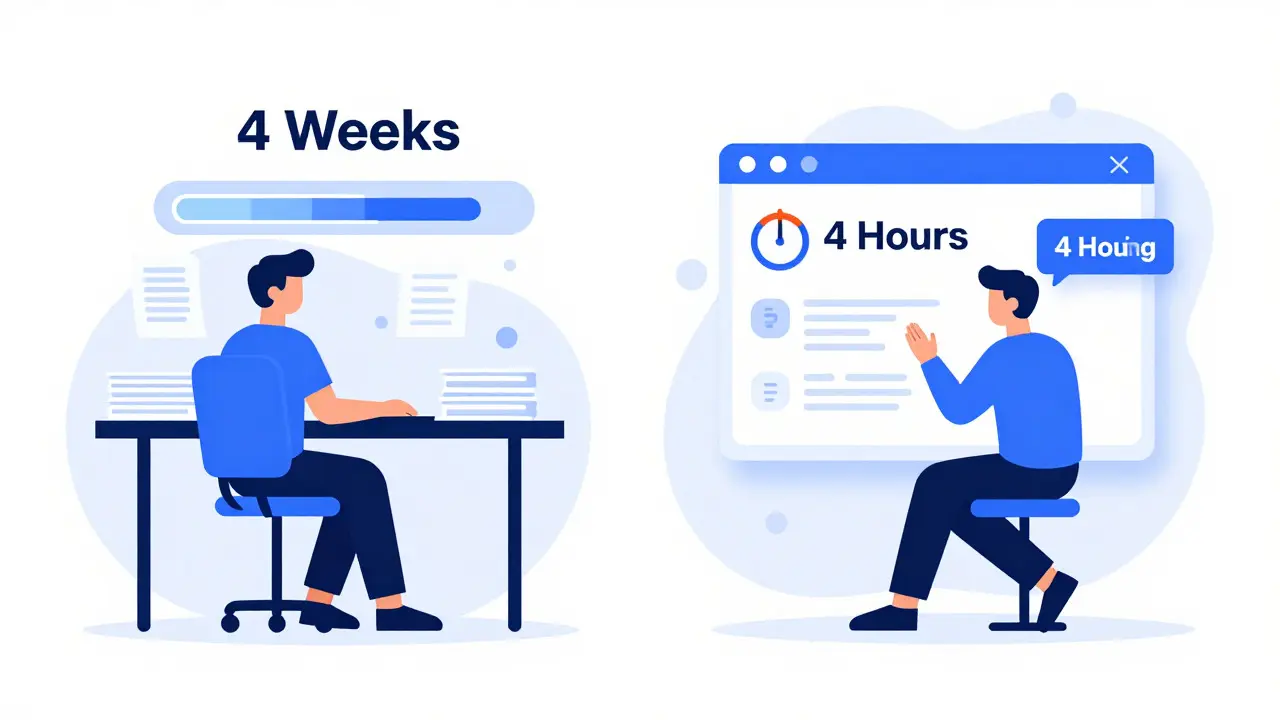
Imagine building an entire web application in four hours instead of four weeks. That is the promise of vibe coding, a development style where engineers use generative AI to produce functional apps through natural language prompts. It sounds like magic until you realize that 40% to 62% of this AI-generated code contains security flaws. The old rules of software security-waiting days or even weeks to patch vulnerabilities-are breaking down. If you are shipping vibe-coded products, your traditional Service Level Agreements (SLAs) are not just outdated; they are dangerous.
The core problem isn't just that AI makes mistakes. It's that these mistakes are different. They aren't simple typos. They are complex logic errors, hardcoded credentials, and exposed endpoints that often only reveal themselves once live user traffic hits them. You can't wait 30 days to fix a vulnerability that was deployed yesterday. This article breaks down how to rewrite your security SLAs for this new reality, focusing on two critical areas: compressing patch windows and defining clear ownership.
Why Traditional Security SLAs Fail Vibe Coding
In traditional software development, security is a gate. You write code, run static analysis tools, pass the tests, and deploy. If a vulnerability is found later, you have a standard window-usually 30 to 90 days-to patch it based on severity. This model assumes code is stable and changes are slow.
Vibe coding flips this upside down. According to Contrast Security's 2025 analysis, vibe coding "fundamentally breaks traditional application security models" because pre-production tools are often bypassed entirely. Developers prioritize speed, pushing unaudited code directly into production. The result? A landscape where 78% of vibe-coded applications contain business logic flaws that evade traditional scanners. These flaws don't break the app during testing; they break it when a hacker exploits them at runtime.
Consider the retail platform case study from GuidePoint Security in October 2025. A team used vibe coding to build a feature, inadvertently embedding customer credit card info into logs sent to third-party telemetry systems. The vulnerability sat undetected for 11 days. In a traditional environment, a static analysis tool might have caught this. In a vibe-coded loop, the code moved too fast, and the error was too subtle for automated pre-deploy checks. By the time customers complained, the damage was done. This highlights why the "gate" approach fails: the pavement itself is shifting beneath your feet.
Redefining Patch Windows: From Weeks to Hours
If deployment velocity increases by 3-5x, as reported by GuidePoint Security, your remediation velocity must match it. The industry consensus is shifting dramatically toward compressed timelines. Dr. Emily Chen from NYU's Center for Cybersecurity argued in May 2025 that the standard 30-day patch window is "dangerously obsolete" for AI-generated code.
Here is what the new benchmarks look like for 2026:
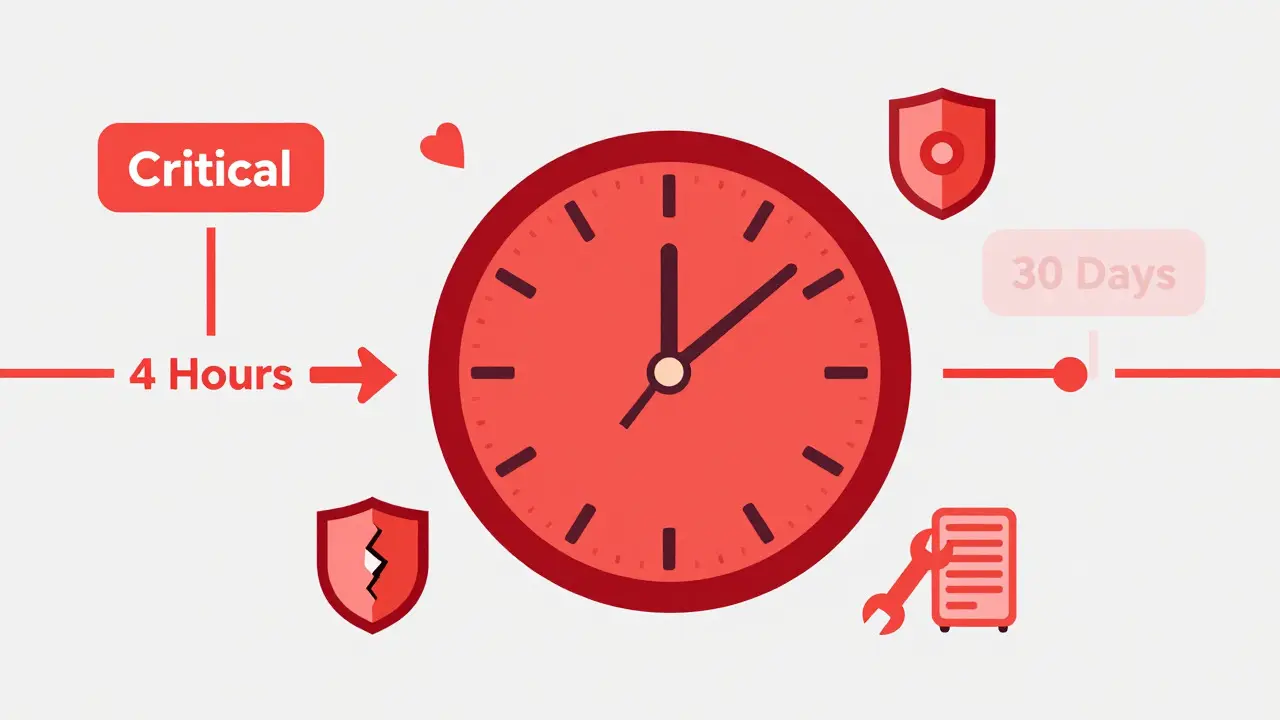
- Critical Vulnerabilities: Remediation within 4 hours. Contrast Security's CTO David Lindner recommends this based on data from 1,200 vibe-coded apps. Some leading frameworks, like the Cloud Security Alliance's December 2025 guidelines, push this even further to 2 hours for critical infrastructure.
- High Severity: Remediation within 24 hours. ZeroPath Security Research notes that 68% of identified vulnerabilities in AI code require action within this window to prevent active exploitation.
- Medium/Low Severity: Standard enterprise timelines may still apply, but only if continuous monitoring confirms no active exploit attempts.
To achieve a 4-hour patch window, you cannot rely on human developers manually writing fixes. You need automated patching capabilities integrated into your CI/CD pipeline. Veracode's Sarah Johnson emphasized in August 2025 that AI-powered remediation tools must be part of the workflow. When a runtime monitor detects an anomaly, the system should trigger an AI agent to generate a patch, test it instantly, and deploy it-all without human intervention for the initial response.
| Vulnerability Severity | Traditional SLA | Vibe-Coding SLA (2026) | Required Tooling |
|---|---|---|---|
| Critical | 30-90 Days | < 4 Hours | Runtime Monitoring (AVM/ADR), Auto-Patching |
| High | 14-30 Days | < 24 Hours | Automated Testing, AI Remediation Agents |
| Medium | 30-60 Days | 7-14 Days | Standard SCA/SAST, Weekly Reviews |
| Low | 90+ Days | 30 Days | Backlog Integration |
Solving the Ownership Gap
Who is responsible when the AI writes bad code? This is the biggest friction point in vibe coding security. In traditional dev, the developer owns the code. In vibe coding, the prompter, the AI model, and the platform provider all share blame. Security Boulevard documented cases where a vibe tool generated a login screen with a hardcoded admin password and auto-committed it to a public GitHub repo. Who pays for the breach? The developer who didn't check? The vendor whose model hallucinated?
The Cloud Security Alliance's December 2025 guidelines offer a clear framework:
- Primary Responsibility: The developer who approved the AI-generated code. Even if they didn't write every line, their approval makes them accountable. This forces a culture of "human-in-the-loop" oversight.
- Secondary Accountability: The AI platform provider. If the failure stems from a known, undocumented flaw in the model's reasoning or a bug in the platform's integration, the vendor bears liability.
- Tertiary Oversight: The organization's security team. They own the environment and the detection mechanisms.
To enforce this, you need provenance tracking. Aikido.dev introduced the Vibe-Coding Assurance Levels (VCAL) framework in early 2025. VCAL-3 and above require capturing a record of the model, prompt, and parameters that generated each snippet. This creates an immutable audit trail. If a vulnerability appears, you can trace it back to the specific interaction. Without this, you are flying blind, and finger-pointing will delay remediation. NYU's research shows that 54% of incidents involving AI code result in blame-shifting rather than fixing.
Shifting Left to Runtime: The New Defense Line
Since pre-production tools like Static Application Security Testing (SAST) are too slow for the vibe coding loop, your primary defense must move to runtime. Contrast Security describes this as moving from "gating" to "pavement." You need visibility while the app is running.
This requires two key technologies:
- Application Vulnerability Monitoring (AVM): Provides essential visibility at runtime. It doesn't just scan code; it watches how the code behaves under load and with real users. It catches the 78% of logic flaws that only manifest in production.
- Application Detection and Response (ADR): Offers real-time protection. If AVM spots an attack pattern, ADR blocks it immediately. This buys you time to generate a patch within your 4-hour SLA.
Implementing this isn't cheap. GuidePoint Security's November 2025 case study showed average implementation costs of $247,000 per organization for custom tooling. However, the cost of a breach in a vibe-coded environment is significantly higher due to the speed of exploitation. Startups are lagging here, with 78% lacking formal security SLAs, making them prime targets for attackers looking for low-hanging fruit.
Practical Steps to Secure Your Vibe-Coded Workflow
You don't need to overhaul your entire stack overnight, but you do need immediate actions. Here is a checklist for establishing secure vibe-coding practices:
- Enforce Provenance Tracking: Configure your AI IDE (like Cursor or Replit) to log prompts and model versions. Use configuration files like `.mdc` in `.cursor/rules` to mandate security standards, such as "Validate all user inputs" and "Sanitize outputs to mitigate XSS."
- Deploy Runtime Monitoring: Integrate AVM and ADR tools before your next major release. Ensure they cover all endpoints, especially those built via AI.
- Compress Internal SLAs: Update your internal incident response plans. Define clear triggers for 4-hour critical patches. Automate the alerting process so security teams aren't waiting for manual reports.
- Train Developers on AI Hallucinations: Educate teams on common AI pitfalls, such as "slopsquatting" (where AI downloads malicious packages with names similar to legitimate ones) and timing-based side-channel attacks in HMAC comparisons.
- Establish Vendor Accountability: Review contracts with AI platform providers. Ensure clauses exist for liability related to documented security failures in their models.
The learning curve is steep. Veracode estimates it takes 3-6 months to develop effective frameworks. But as Gartner projects that 65% of enterprise code will involve AI assistance by 2027, waiting is not an option. Organizations that fail to establish these SLAs face a 3.7x higher breach risk. Those that adapt can achieve security parity with traditional development within 18 months.
Regulatory Landscape and Future Outlook
Regulators are catching up. The EU's AI Act amendments in June 2025 now require provenance tracking for all AI-generated code in critical infrastructure. The U.S. NIST released draft guidelines in August 2025 mandating runtime security monitoring for generative AI applications. These aren't suggestions; they are becoming compliance requirements.
By 2027, Forrester predicts that 90% of enterprises will have specific security SLAs for AI-generated code. The market for AI-specific security tools is already booming, valued at $4.2 billion in Q3 2025. Companies like Contrast Security, Veracode, and Aikido.dev are racing to provide the necessary infrastructure. The future of vibe coding security lies in automation, transparency, and speed. If you treat AI-generated code like traditional code, you will lose. Treat it like a high-velocity asset requiring constant, intelligent surveillance, and you can harness its power safely.
What is a realistic patch window for critical vulnerabilities in vibe-coded apps?
For critical vulnerabilities, a patch window of under 4 hours is the current industry standard recommended by experts like Contrast Security's CTO. Some frameworks suggest even tighter windows of 2 hours for critical infrastructure. This is a significant reduction from the traditional 30-90 day windows, driven by the rapid deployment cycles and high prevalence of runtime-only logic flaws in AI-generated code.
Who is responsible for security flaws in AI-generated code?
Primary responsibility lies with the developer who approved the AI-generated code. Secondary accountability falls on the AI platform provider if the flaw stems from a known model issue. Tertiary oversight belongs to the organization's security team. Clear provenance tracking is essential to assign blame and ensure timely remediation, avoiding the finger-pointing that delays fixes.
Why are traditional security tools like SAST insufficient for vibe coding?
Static Application Security Testing (SAST) is often perceived as too slow for the rapid vibe coding loop. More importantly, 78% of vulnerabilities in vibe-coded apps are business logic flaws that only manifest with live user traffic, evading pre-production scanners. Runtime security tools like AVM and ADR are needed to catch these dynamic issues.
What is the Vibe-Coding Assurance Levels (VCAL) framework?
VCAL is a framework introduced by Aikido.dev to structure security in AI development. It ranges from VCAL-1 (AI suggests code with human oversight) to VCAL-5 (fully autonomous merges for low-risk changes). VCAL-3 and above require guardrails and provenance capture, recording the model, prompt, and parameters used to generate code snippets for accountability.
How can organizations implement automated patching for AI code?
Organizations should integrate AI-powered remediation tools directly into their CI/CD pipelines. When runtime monitoring detects a vulnerability, an AI agent can automatically generate a patch, test it in a sandbox environment, and deploy it if successful. This automation is crucial for meeting the sub-4-hour patch windows required for critical vulnerabilities.
Stephanie Frank
July 20, 2026 AT 04:44honestly this whole vibe coding trend is just a fancy way for companies to fire their senior devs and replace them with interns who copy paste garbage from chatgpt. you think a 4 hour patch window is fast? try explaining to your board why the customer database leaked because some junior dev thought 'it looks like it works' was a valid security strategy. the industry is drowning in technical debt and nobody wants to admit it.
Lisa Puster
July 22, 2026 AT 00:39typical american sloppiness. we rush everything into production without thinking about consequences. look at how european regulators are actually stepping up with the ai act while us just keeps chasing speed over quality. its embarrassing really. we need stricter laws here not more buzzwords. if our engineers cant write secure code without an ai crutch then maybe we should stop pretending we lead in tech anymore
Joe Walters
July 23, 2026 AT 16:31wait hold on. im a senior architect and i have to tell you guys something. this article is missing the forest for the trees. yes ai makes mistakes but human devs make mistakes too. the real issue is that management wont invest in proper tooling. they want magic buttons. meanwhile im stuck fixing regex injections at 3am because some intern used cursor to generate a login page. its tragic honestly. my hairline is retreating faster than the market cap of tesla
Robert Barakat
July 25, 2026 AT 08:56the concept of ownership dissolves when the creator is non-conscious. we are witnessing the death of authorship in software engineering. if the machine hallucinates a vulnerability, is it a bug or a feature of reality itself? perhaps the vulnerability was always there, waiting in the latent space for a prompt to manifest it. we blame the developer but the developer is merely a conduit for the collective unconscious of the training data. it is a philosophical crisis disguised as a technical one.
Michael Richards
July 26, 2026 AT 01:06listen up. if you are still using traditional slas you are already dead. the only people surviving this shift are the ones who automate everything. stop blaming the ai. start blaming your lack of runtime monitoring. you need avm and adr tools integrated yesterday. if your cto doesnt know what vcals are by next week fire them. simple as that. competence is not optional.
Laura Davis
July 27, 2026 AT 15:19i feel like everyone is so angry about this but lets take a breath. change is hard. sure the risks are real but imagine the potential if we get this right. we can build things so much faster. let's support each other through this transition. maybe we can form study groups to learn these new frameworks together? no one has to face the hype cycle alone. we can do this if we stay positive and communicate openly about our fears and failures.
Lisa Nally
July 28, 2026 AT 11:13oh darling please. you really think a checklist is going to save you? the epistemological framework of vibe coding requires a complete overhaul of your mental model regarding provenance. most of you are operating at vcals-1 which is essentially digital negligence. you need to understand the semantic implications of prompt injection vectors before you even think about deploying to prod. it is quite frankly adorable how unprepared you all are for the ontological shift in software delivery pipelines.
Edward Gilbreath
July 28, 2026 AT 11:57they want you to believe its about security. its not. its about control. the big tech vendors want you locked into their proprietary ai ecosystems so they can harvest your proprietary logic. once you start using their auto-patching tools you never leave. the vulnerabilities are probably planted intentionally to force adoption. wake up sheeple. read the source code. trust nothing.