Self-Attention and Positional Encoding: The Core of Transformer Architecture
 Sep, 20 2026
Ever wondered why your chatbot suddenly started sounding human around 2018? It wasn't magic. It was a shift in how computers read sentences. Before that, models read words one by one, like a person reading with their finger on the line, often forgetting what they read at the start by the time they hit the end. Then came Transformer architecture, a neural network design that processes entire sequences simultaneously using self-attention mechanisms. This change didn't just tweak performance; it rewrote the rules of natural language processing.
At the heart of this revolution are two specific components: self-attention and positional encoding. Together, they allow machines to understand context and order without the sequential bottlenecks of older systems. If you've ever tried to explain why "I love cats" means something different from "Cats love I," you're grappling with the exact problem these mechanisms solve. Let's break down how they work, why they matter for modern generative AI, and what makes them so effective.
The Problem with Reading One Word at a Time
To appreciate the Transformer, you have to look at what came before. Recurrent Neural Networks (RNNs) were the standard for sequence data. They worked sequentially: process word 1, update memory, process word 2, update memory again. Simple enough. But this approach had fatal flaws.
- Speed: You couldn't parallelize training. Each step depended on the previous one, making training slow on massive datasets.
- Memory Decay: RNNs struggled to retain information over long distances. In a 50-word sentence, the connection between the first and last word often faded into noise.
- Gradient Issues: Backpropagation through time led to vanishing or exploding gradients, making deep networks hard to train.
Convolutional Neural Networks (CNNs) offered some parallelism but lacked the dynamic flexibility to handle variable-length dependencies effectively. Enter the Transformer, introduced in the 2017 paper "Attention Is All You Need." It ditched recurrence entirely. Instead of moving through the sequence step-by-step, it looked at everything at once. But looking at everything at once creates a new problem: chaos. Without order, "dog bites man" looks identical to "man bites dog." That's where the dual engine of self-attention and positional encoding kicks in.
Self-Attention: Connecting the Dots Across Distance
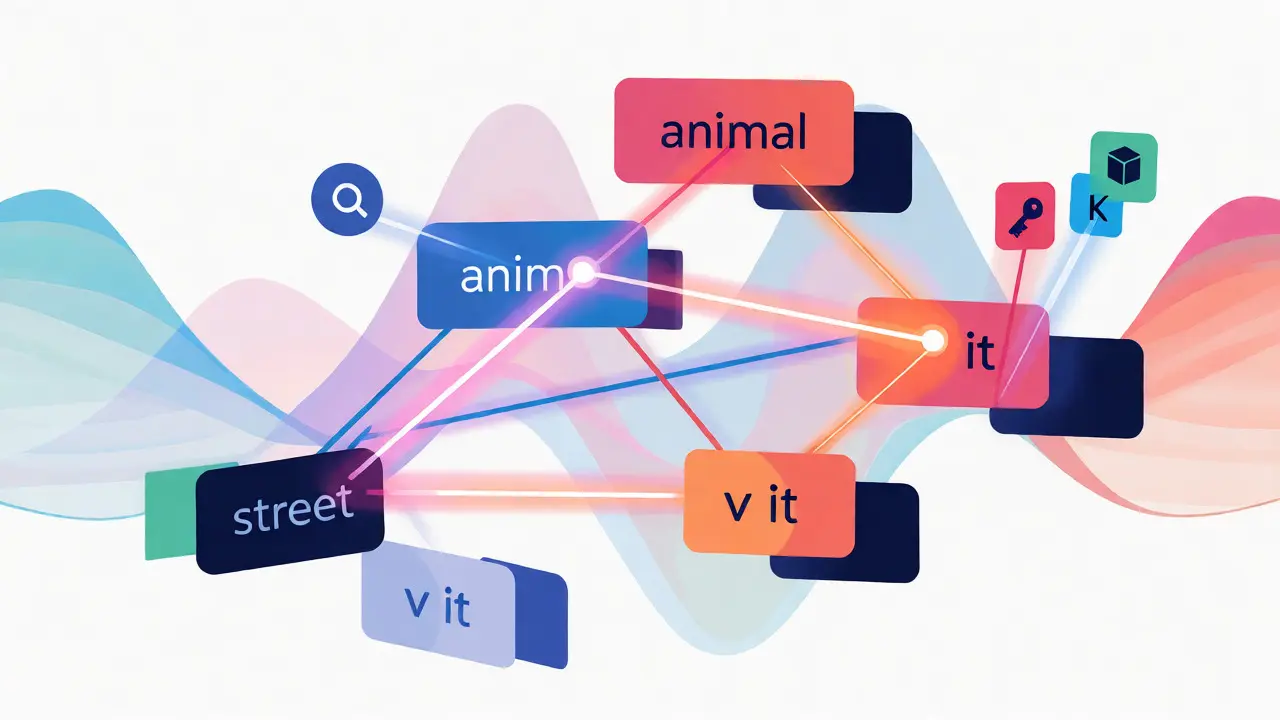
Self-attention is a mechanism that allows a model to weigh the importance of different words in a sequence relative to each other. Think of it as highlighting relevant parts of a text while ignoring irrelevant ones. When you read the sentence "The animal didn't cross the street because it was too tired," your brain instantly knows "it" refers to "animal," not "street." Self-attention does the same thing mathematically.
Here is how it works under the hood. For every word in the input, the model generates three vectors: Query (Q), Key (K), and Value (V). These aren't arbitrary; they are learned linear projections of the input embeddings.
- Query (Q): What am I looking for?
- Key (K): What do I contain?
- Value (V): What information do I carry if matched?
The core formula is Attention(Q, K, V) = softmax(QK^T / √d_k)V. Don't let the notation scare you. It essentially calculates a similarity score between every word's query and every other word's key. High similarity means high attention weight. The division by √d_k prevents the scores from becoming too large, which would push the softmax function into regions with tiny gradients, slowing down learning.
This mechanism captures long-range dependencies effortlessly. Whether the reference is two words away or two hundred, the computational cost remains constant per pair. This is a massive advantage over RNNs, where the path length between distant tokens grows linearly, increasing error propagation.
| Feature | RNN/LSTM | CNN | Transformer |
|---|---|---|---|
| Processing Method | Sequential | Parallel (fixed window) | Parallel (global) |
| Long-Range Dependency | Weak (vanishing gradient) | Moderate (limited by kernel size) | Strong (direct connections) |
| Training Speed | Slow (no parallelism) | Fast | Very Fast (highly parallelizable) |
| Parameter Efficiency | Low | Moderate | High (but requires more data) |
Multi-Head Attention: Seeing Different Angles
A single attention head might miss nuances. A sentence has syntax, semantics, sentiment, and coreference all happening at once. To handle this, Transformers use multi-head attention. Instead of performing one attention operation on the full embedding dimension, the model splits the queries, keys, and values into h smaller heads (typically 8 in the original implementation).
Each head operates independently in its own subspace. One head might focus on syntactic relationships (like subject-verb agreement), while another tracks semantic links (like synonymy). Another might track coreference (who "he" refers to). Finally, the outputs of all heads are concatenated and projected back to the original dimension.
This specialization allows the model to jointly attend to information from different representation subspaces at different positions. It’s like having a team of experts review a document-one checks grammar, another checks facts, another checks tone-before combining their insights.
Positional Encoding: Restoring Order to Chaos
Self-attention is permutation-invariant. Shuffle the words in a sentence, and the attention weights just shuffle with them; the model doesn't inherently know which word came first. This is disastrous for language, where order defines meaning. We need to inject position information.
The original Transformer uses sinusoidal positional encoding. These are fixed functions added directly to the token embeddings before the input hits the encoder. The formulas are:
- PE(pos, 2i) = sin(pos / 10000^(2i/d_model))
- PE(pos, 2i+1) = cos(pos / 10000^(2i/d_model))
Why sine and cosine? Because they create unique signatures for each position across dimensions. Lower dimensions oscillate rapidly (high frequency), capturing fine-grained local positions. Higher dimensions oscillate slowly (low frequency), capturing coarse global positions. Crucially, for any fixed offset δ, PE(pos + δ) can be represented as a linear projection of PE(pos). This mathematical property allows the model to easily learn relative positions, even if it hasn't seen that specific distance during training.
Without this, "I eat apple" and "apple eat I" would look identical to the attention mechanism. With it, the model learns that verbs typically follow subjects, not precede them.
From Architecture to Generative AI
How does this enable generative AI? The key lies in the decoder's masked self-attention. During generation, the model predicts the next word based only on previous words. It cannot peek at future tokens. This masking ensures autoregressive behavior: the output depends strictly on the past.
Models like GPT-3 leverage this structure to generate coherent text. They predict the next token, append it to the sequence, recompute attention, and predict the next one. The efficiency of self-attention allows these models to scale to billions of parameters. GPT-3, with 175 billion parameters, relies on the parallel processing capabilities of the Transformer to train on vast amounts of data in reasonable timeframes.
The impact is measurable. On benchmarks like GLUE, Transformer-based models like BERT achieved average scores exceeding 80, compared to ~60 for previous state-of-the-art models. In translation tasks, Transformers outperformed RNNs by significant margins, achieving BLEU scores over 40 on complex language pairs where previous models struggled to reach 30.

Challenges and Modern Evolutions
Transformers aren't perfect. The quadratic complexity of self-attention (O(n²)) becomes a bottleneck for very long sequences. Processing a 10,000-token document requires computing attention scores for every pair, consuming massive memory. This is why early models capped context lengths at 512 or 2,048 tokens.
Recent innovations aim to fix this:
- Sparse Attention: Techniques like Longformer limit attention to local windows plus a few global tokens, reducing complexity to O(n).
- Rotary Position Embeddings (RoPE): Used in LLaMA models, RoPE encodes absolute position information via rotation matrices, improving extrapolation to longer sequences.
- ALiBi: Google's method adds a linear bias to attention scores based on distance, eliminating the need for explicit positional encodings in some cases.
Despite these challenges, the core principles remain. Self-attention provides the context; positional encoding provides the structure. Together, they form the backbone of modern NLP.
Practical Implementation Tips
If you're building or studying Transformers, keep these pitfalls in mind:
- Scaling Factor: Always divide QK^T by √d_k. Forgetting this causes softmax saturation, killing gradients.
- Masking: Ensure the causal mask in decoders is triangular. Incorrect masking leads to data leakage, where the model cheats by seeing future tokens during training.
- Embedding Dimension: Sinusoidal encodings require d_model to be divisible by 2. Mismatched dimensions cause shape errors in frameworks like PyTorch or TensorFlow.
Understanding these mechanics demystifies the "black box" of AI. It's not magic; it's matrix multiplication guided by clever architectural choices.
Why is self-attention better than RNNs for long sequences?
Self-attention connects every token to every other token directly, regardless of distance. RNNs pass information sequentially, causing signals to fade over long paths. This direct connection allows Transformers to capture long-range dependencies much more effectively and enables parallel processing, significantly speeding up training.
What happens if you remove positional encoding?
The model loses the ability to distinguish word order. Since self-attention is permutation-invariant, shuffling the input words would result in the same output distribution. The model could identify keywords but wouldn't understand grammar or syntax, such as who performed an action versus who received it.
Why use sinusoidal functions for positional encoding?
Sinusoidal functions allow the model to generalize to sequence lengths longer than those seen during training. Their periodic nature means that relative positions can be represented as linear transformations, helping the model learn patterns like "the word after X" even if it hasn't encountered that specific absolute position before.
Can positional encoding be learned instead of calculated?
Yes, many modern models like BERT use learned positional embeddings. However, learned embeddings are limited to the maximum sequence length defined during training. Sinusoidal encodings are fixed and can theoretically extrapolate to longer sequences, though learned embeddings often perform slightly better within their trained limits due to greater flexibility.
How does multi-head attention improve performance?
It allows the model to focus on different types of relationships simultaneously. One head might track syntactic structure, another semantic similarity, and another coreference. By combining these perspectives, the model gains a richer understanding of the input than a single attention mechanism could provide.