Stepwise Prompting with Feedback Loops: Iterating Toward Correct Code
 Oct, 29 2026
You ask an AI to write a function. It spits out 50 lines of Python. You paste it in. It crashes. You ask it to fix the error. It rewrites the whole thing, breaking two other parts you didn't even know were connected. Sound familiar? This is the "black box" trap of modern AI-assisted coding. We treat Large Language Models like magic wands, expecting them to pull perfect software out of thin air. But they aren't wizards; they're probabilistic engines. If you want reliable code, you have to stop asking for miracles and start demanding evidence.
This is where Stepwise Prompting with Feedback Loops comes in. It’s not just a buzzword-it’s a methodology that combines structured prompt engineering with the old-school discipline of test-driven development. Instead of asking for the final product, you guide the model through small, verifiable steps, checking its work at every turn. Think of it as pair programming with a very fast, but occasionally hallucinating, junior developer who needs constant supervision.
Why Direct Generation Fails (And Why You’re Wasting Time)
When you ask a model like GPT-4 or Claude 3 to generate a complex algorithm in one go, you’re betting everything on its ability to hold a massive context window in memory while simultaneously reasoning about syntax, logic, and edge cases. A 2023 Stack Overflow Developer Survey found that while 44.9% of developers use AI tools, only 17.3% trust the output without verification. That gap is where bugs live.
Direct prompting often leads to what researchers call "reasoning drift." The model starts strong but loses track of constraints as the code gets longer. By using stepwise prompting, you break this cognitive load into manageable chunks. You force the model to explain its reasoning before writing code, a technique known as Chain-of-Thought (CoT) prompting. Research from Google Research showed that CoT can boost accuracy on complex reasoning tasks from 17.7% to 78.7%. In coding, this translates to fewer logical errors because the model isn’t just guessing the next token; it’s following a plan it created itself.
The Core Mechanism: How Stepwise Prompting Works
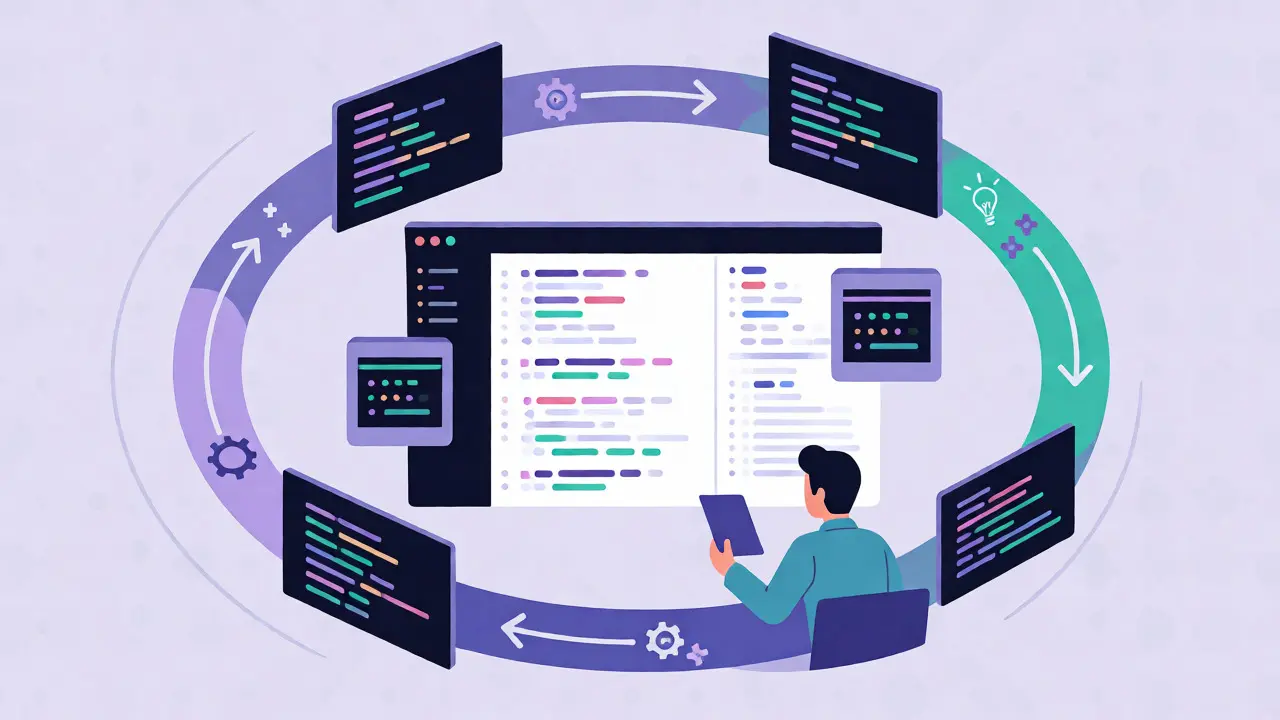
The method relies on three pillars: decomposition, validation, and iteration. You don't ask for the solution; you ask for the first step of the solution. Then you verify it. Then you ask for the next step.
- Decomposition: Break your problem into atomic units. Instead of "Write a user authentication system," try "Create a function to hash passwords using bcrypt."
- Validation: Before moving on, demand a test case. "Provide a unit test that verifies this hashing function works correctly."
- Iteration: Run the test. If it fails, feed the error back to the model. If it passes, move to the next component.
This approach mimics the REPL (Read-Eval-Print Loop) paradigm used in interactive programming environments. It turns the opaque process of code generation into a transparent, debuggable workflow. As Dr. Percy Liang from Stanford noted, this shifts AI interaction from black-box generation to a process you can actually audit.

Building Your First Feedback Loop
So, how do you actually do this without spending all day typing prompts? You need a structure. One effective pattern is the "3C Framework": Context, Challenge, Criteria.
- Context: Give the model the necessary background. "We are building a Python data pipeline using Pandas. The input is a CSV file with columns 'date', 'sales', and 'region'."
- Challenge: Define the specific subtask. "Write a function that filters rows where sales are greater than 1000. Do not handle missing values yet."
- Criteria: Set the acceptance test. "Include a pytest example that creates a dummy DataFrame and asserts the filter returns exactly two rows."
By restricting the scope, you prevent the model from over-engineering or hallucinating features you didn’t ask for. When the model generates the code, you run the test immediately. If it fails, you don’t rewrite the prompt from scratch. You simply paste the error message back into the chat: "The test failed with KeyError: 'sales'. Fix the function." This tight loop reduces debugging time significantly-some developers report up to a 60% reduction when tackling complex parsers or algorithms.
When to Use It (And When Not To)
Not every task benefits from this overhead. If you’re writing a simple "Hello World" or a standard CRUD endpoint, stepwise prompting is overkill. The cognitive cost of crafting ten precise prompts outweighs the benefit of verifying each line. However, for multi-step logic, data transformations, or algorithmic challenges, it’s indispensable.
| Approach | Best For | Error Rate | Cognitive Load |
|---|---|---|---|
| Direct Generation | Simple boilerplate, basic syntax | High (on complex tasks) | Low |
| Stepwise + Feedback | Algorithms, data pipelines, new frameworks | Low (verified steps) | Medium-High |
| Traditional TDD | Legacy systems, strict compliance | Very Low | High |
A study from Stanford’s Center for Research on Foundation Models indicated that stepwise approaches reduce error rates by 63% compared to direct generation on medium-difficulty LeetCode problems. The trade-off is time. You spend more time prompting, but less time debugging. For senior developers, this trade-off is almost always worth it. For juniors, it requires practice to avoid getting stuck in "prompt paralysis," where you tweak wording endlessly instead of testing code.
Common Pitfalls and Pro Tips
The biggest mistake people make is making steps too big. If you ask for "the database layer," that’s still too vague. Ask for "the connection string configuration." Another issue is context loss. Even with models like Claude 3 supporting 200k tokens, long chains of reasoning can dilute attention. Keep your feedback loops short. If a conversation exceeds 20 exchanges, summarize the current state and start a new thread with that summary as context.
Also, be wary of the "illusion of reasoning." Just because a model explains its steps doesn’t mean it’s correct. Margaret Mitchell from Google Research warns that stepwise prompting can mask fundamental limitations if the problem lies outside the model's training distribution. Always read the generated tests. If the test is trivial (e.g., `assert True`), the model is cheating. Demand meaningful assertions.
The Future of AI-Assisted Development
We are moving toward integrated workflows. Tools like GitHub Copilot Workspaces are starting to embed these feedback mechanisms directly into the IDE, automatically suggesting when a prompt should be broken down. By 2025, analysts predict that structured feedback loops will become as standard in AI coding as unit testing is today. The goal isn't to replace human judgment but to augment it with rigorous verification. Stop treating AI as an oracle. Treat it as a collaborator that needs clear instructions and immediate consequences.
What is the difference between Chain-of-Thought and Stepwise Prompting?
Chain-of-Thought (CoT) is a technique where the model explains its reasoning process before giving an answer. Stepwise Prompting is a broader workflow that breaks a task into sequential steps, often using CoT within each step, but crucially adds external validation (tests) between steps. CoT helps internal reasoning; Stepwise ensures external correctness.
Do I need expensive AI models for this to work?
No. While larger models like GPT-4 or Claude 3 handle complex contexts better, smaller open-source models like CodeLlama or Mistral can perform well with stepwise prompting because the tasks are simplified. The methodology compensates for lower model capability by reducing the complexity of each individual request.
How do I know if my steps are too small or too large?
A good rule of thumb: if a step takes more than 10-15 lines of code or involves multiple distinct logical concepts (e.g., parsing AND validating), it’s too big. If a step produces no testable output or feels trivial (like importing libraries), it’s too small. Aim for single-responsibility functions or classes.
Can I automate the feedback loop?
Yes, partially. Tools like pytest or Jest can run tests automatically. Some advanced setups use scripts to send failing test outputs back to the LLM API for auto-correction. However, human review is still recommended for architectural decisions and security-sensitive code.
Is this useful for web development?
It depends. For backend logic, APIs, and data processing, yes. For UI components or CSS styling, direct generation is often faster since visual verification is immediate and low-risk. Use stepwise prompting for the business logic behind the UI.