Test Set Leakage in LLMs: How to Detect Data Contamination and Decontaminate Benchmarks
 Aug, 11 2026
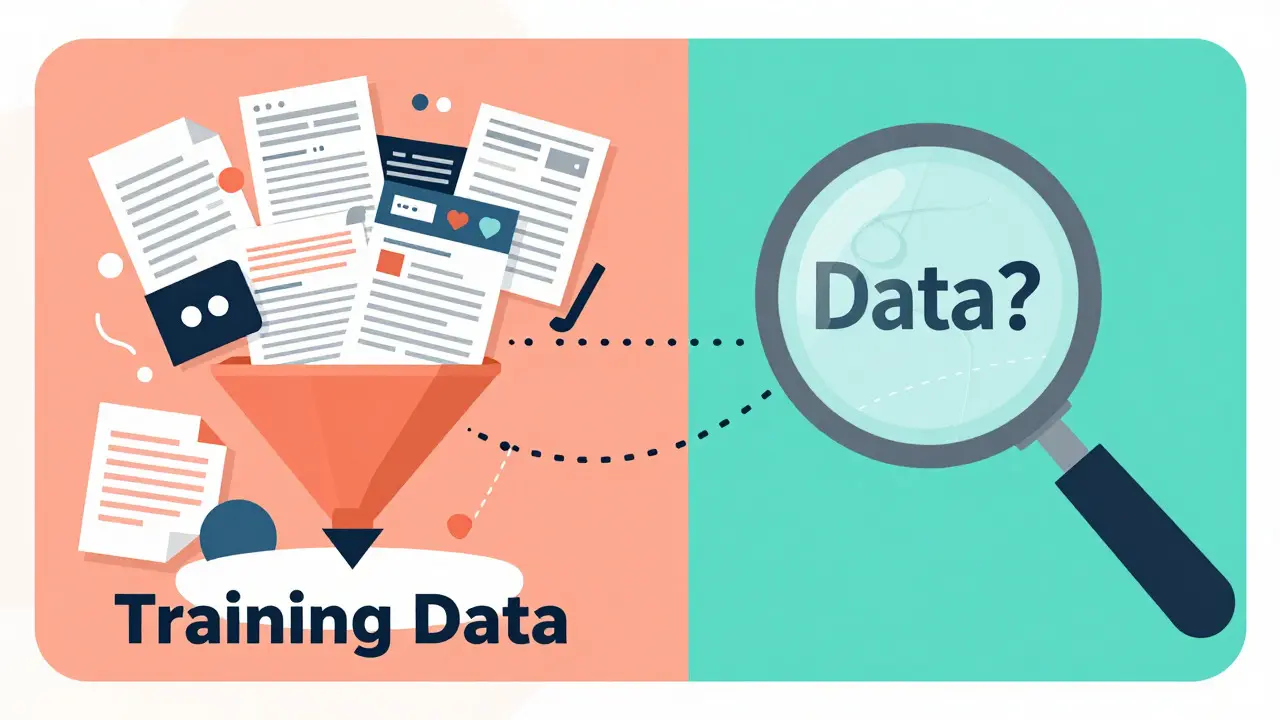
Imagine hiring a candidate who scores 95% on a practice exam. You’re thrilled-until you realize they memorized the answer key during training. That is exactly what happens with test set leakage, also known as data contamination, in the process of evaluating Large Language Models (LLMs) using benchmarks that were inadvertently included in their training data. This phenomenon creates a false sense of security, inflating performance metrics by 15-30% and masking genuine reasoning capabilities.
In April 2024, researchers Ruijie Xu, Zengzhi Wang, Run-Ze Fan, and Pengfei Liu published a landmark study analyzing 31 LLMs. They found substantial instances of test set misuse across mathematical reasoning tasks. The issue isn’t just academic; it affects real-world deployment decisions. If your model passes a contaminated benchmark but fails in production, you risk costly errors in high-stakes domains like healthcare or finance.
The Mechanics of Benchmark Leakage
To understand how leakage occurs, we need to look at the training pipeline. Modern LLMs are trained on massive datasets scraped from the internet. These datasets often include GitHub repositories, public forums, and educational sites where standard benchmarks like MMLU (Massive Multitask Language Understanding) or HumanEval reside. When a model sees these questions during pre-training, it doesn’t learn to reason-it learns to recall.
Detection relies on measuring how "surprised" a model is by benchmark questions. The primary metrics used are perplexity and N-gram accuracy. Perplexity measures prediction precision; low perplexity on a test question suggests the model has seen it before. In their detection pipeline, Xu et al. revealed that models exhibiting leakage show significantly higher accuracy on contaminated benchmarks compared to decontaminated versions.
Consider the TS-Guessing protocol developed for OpenReview. It tests contamination through two subtasks:
- Question-based setting: The model guesses missing portions of complex questions. Contaminated models achieve 65-85% accuracy here, while clean models score only 25-40%.
- Question-Multichoice setting: The model predicts missing options. Here, contaminated models score 70-90%, versus 30-45% for non-contaminated ones.
These gaps aren’t minor statistical noise-they represent a fundamental breakdown in evaluation integrity. Dr. Yoav Goldberg from the Allen Institute for AI described the field as being in "crisis mode," noting that 22 of 25 major LLMs exhibited significant leakage on math benchmarks in his July 2024 analysis.
Decontamination Strategies That Work
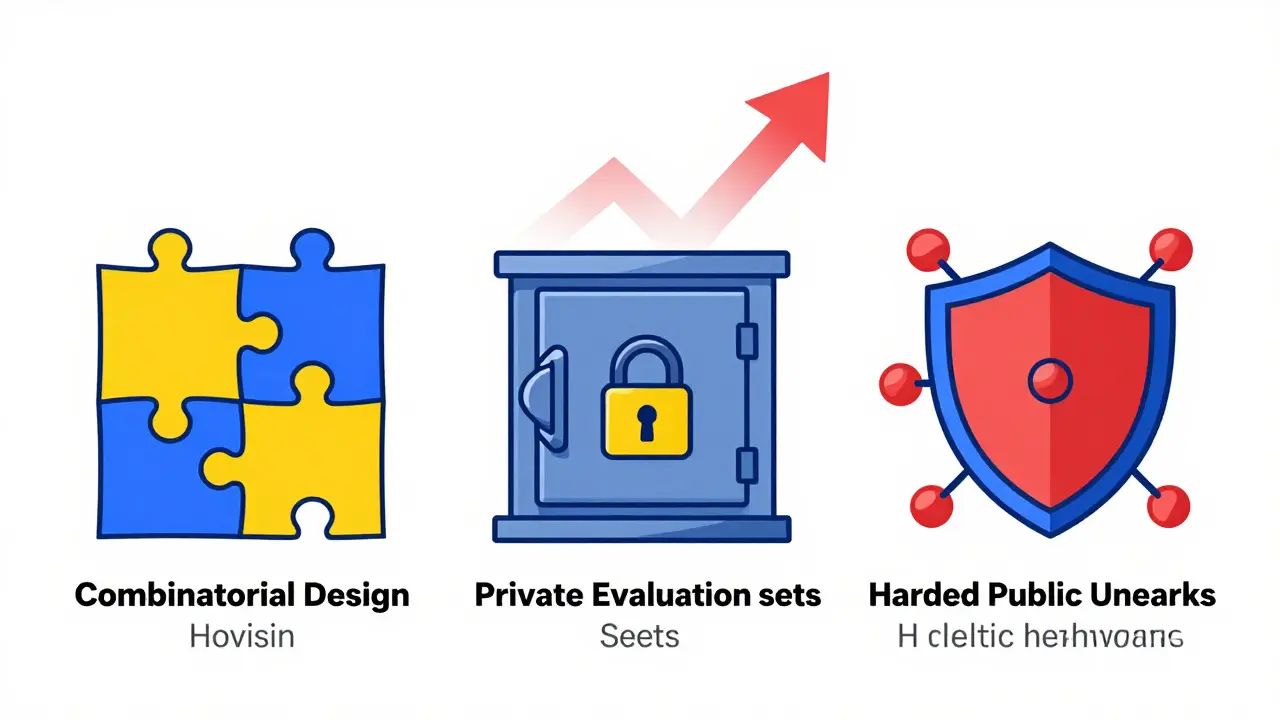
If leakage is the problem, decontamination is the solution. But how do you clean a dataset without breaking it? There are three main approaches currently in use, each with trade-offs.
1. Combinatorial Test Design
This method involves creating dynamic variations of existing problems. Instead of asking a static coding question, you generate templated variants. For example, HumanEval T is a templated variant of the original HumanEval benchmark. PromptLayer’s research showed that GPT-4 and Claude 3 experienced 12-18 percentage point performance drops on HumanEval T compared to the original. This drop indicates that the models had memorized the original questions but lacked the flexibility to solve novel variations.
2. Private Evaluation Sets
The most robust solution is keeping test data completely offline. Holistic AI’s September 2024 analysis demonstrated that private benchmarks correlate 0.85 with real-world performance, whereas public benchmarks only correlate 0.45. However, this approach is expensive. Creating custom test sets requires 200-300 hours of domain expert time per benchmark, according to DataForce.ai.
3. Hardened Public Benchmarks
Some initiatives aim to create public benchmarks that are resistant to leakage. MMLU-Hard, released in October 2024, filters out easy questions and those likely present in training data. Similarly, the BigCode initiative launched CodeEval-Hard, which showed performance drops of 15-22 percentage points across major code models, exposing hidden weaknesses.
| Method | Cost/Effort | Effectiveness | Best For |
|---|---|---|---|
| Combinatorial Design | Medium (Automated) | High | Coding & Logic Tasks |
| Private Sets | Very High ($120k+) | Highest | Enterprise Deployment |
| Hardened Public | Low | Moderate | Academic Research |
Real-World Impact: Why Accuracy Matters
The consequences of ignoring leakage extend beyond inflated charts. On r/MachineLearning, user 'AI_Evaluator87' documented a 22-point performance gap between standard MMLU and their custom decontaminated version when evaluating models for enterprise deployment. This discovery led them to switch vendors entirely.
In financial services, the stakes are even higher. A case study by DataForce.ai detailed how a company reduced false positives in fraud detection models by 37% after implementing private benchmarks. Before decontamination, they were optimizing for metrics that didn’t reflect actual fraud patterns.
However, there are challenges. IBM’s October 2024 whitepaper noted that private datasets frozen in time face "linguistic drift," with a 15% annual decay rate in effectiveness. As language evolves, static benchmarks become less relevant. This is why continuous evolution of test sets is critical.
Expert Perspectives and Future Trends
Not everyone agrees on the severity of the issue. Dr. Dario Amodei of Anthropic argued in September 2024 that some data overlap is inevitable-and even desirable-for models operating in real-world information ecosystems. After all, humans learn from the same sources we evaluate them on.
Yet, the trend is clear. The Association for Computational Linguistics (ACL) issued an official statement in August 2024 recommending immediate adoption of private evaluation sets for all future research submissions. Regulatory pressure is mounting too. The EU AI Act’s November 2024 amendments require demonstrable decontamination protocols for high-risk AI systems.
Looking ahead, Gartner forecasts that by 2027, 85% of enterprises will use custom, domain-specific benchmarks rather than standardized public ones. We are moving toward a fragmented landscape where comparability between models becomes harder, but reliability increases.
How to Start Decontaminating Your Benchmarks
If you’re ready to improve your evaluation framework, here’s a practical roadmap:
- Audit Current Benchmarks: Use tools like Xu et al.’s publicly available pipeline on GitHub to check for leakage in your current test sets. Look for unusually low perplexity scores on specific questions.
- Adopt Hardened Variants: Switch to MMLU-Hard or CodeEval-Hard for initial testing. These provide a quick win without heavy engineering effort.
- Build Private Sets: Allocate resources for domain experts to create custom questions. Focus on scenarios unique to your business logic that won’t appear in public datasets.
- Implement Combinatorial Generation: Use templates to dynamically generate test cases. This reduces manual creation time by up to 70%, according to PromptLayer.
- Monitor Continuously: Treat benchmark maintenance as an ongoing process, not a one-time fix. Re-evaluate quarterly to catch new leaks.
Remember, the goal isn’t perfection-it’s honesty. An accurate score of 60% is far more valuable than a misleading 90%. By prioritizing decontamination, you ensure your AI investments drive real value, not just vanity metrics.
What is test set leakage in LLMs?
Test set leakage occurs when benchmark questions used to evaluate a Large Language Model are accidentally included in its training data. This causes the model to memorize answers rather than learn reasoning skills, leading to artificially high performance scores that don't reflect true capability.
How can I detect if my benchmark is contaminated?
You can detect contamination by measuring perplexity and N-gram accuracy on benchmark questions. Low perplexity suggests the model has seen the data before. Tools like the TS-Guessing protocol or open-source pipelines from Xu et al. can help identify leaked data by comparing performance against decontaminated variants.
Is MMLU still a reliable benchmark?
Standard MMLU is increasingly compromised due to widespread data contamination. Many top-performing models have been exposed to MMLU questions during training. For more reliable results, consider using hardened versions like MMLU-Hard or creating private, domain-specific benchmarks tailored to your needs.
What is combinatorial test design?
Combinatorial test design involves generating dynamic variations of existing problems using templates. Instead of static questions, you create multiple permutations that test the same underlying skill. This prevents memorization because the model hasn't seen the specific variation before, forcing it to apply reasoning.
How much does it cost to create a private benchmark?
Creating a robust private benchmark typically requires 200-300 hours of domain expert time per benchmark. Depending on team size and rates, this can cost anywhere from $50,000 to over $120,000. While expensive, it offers the highest correlation with real-world performance and protects against data leakage.
Will regulatory bodies enforce decontamination standards?
Yes, regulations are emerging. The EU AI Act's November 2024 amendments require demonstrable decontamination protocols for high-risk AI systems. This means companies deploying LLMs in sensitive areas like healthcare or finance must prove their evaluation methods are free from data leakage to remain compliant.
What is the difference between perplexity and accuracy in detecting leakage?
Accuracy measures whether the model gets the right answer, while perplexity measures how surprised the model is by the text. A model with high accuracy but low perplexity on a test set likely memorized the content. Perplexity is a stronger indicator of leakage because it reveals prior exposure even if the final answer is correct by chance.
Are there any benefits to data contamination?
Some experts argue that limited overlap is inevitable since models train on public data. Dr. Dario Amodei suggests it may be desirable for models operating in real-world ecosystems. However, for rigorous evaluation, contamination obscures true reasoning ability, making it difficult to compare models fairly or assess safety risks accurately.