Third-Country Data Transfers for Generative AI: GDPR and Cross-Border Issues
 Jun, 26 2026
Imagine your employee types a sensitive customer record into a popular generative AI is a technology that processes vast amounts of data to generate text, code, or images. chatbot. In milliseconds, that data might travel from an office in Berlin to servers in the United States, then to a cloud provider in Singapore, before returning as a summary. For many organizations, this invisible journey happens without anyone realizing it has occurred. Under the General Data Protection Regulation (GDPR) is the European Union's comprehensive data protection law enacted in 2018., this scenario triggers a complex web of legal obligations regarding third-country data transfers.
If you are managing data privacy in Europe, the rules have tightened significantly. The era of assuming that standard contracts cover all bases is over. With the European Data Protection Board (EDPB) is the EU body responsible for ensuring consistent application of data protection laws across member states. releasing its final Guidelines 02/2024 on Article 48 GDPR in June 2025, regulators are sending a clear message: opacity in AI supply chains is no longer an acceptable excuse for non-compliance. This article breaks down what these changes mean for your business, how to navigate cross-border issues with generative AI, and the practical steps you need to take right now to avoid multimillion-euro fines.
The Core Problem: AI Architecture vs. Territorial Restrictions
Generative AI systems are inherently global. They rely on massive datasets and distributed computing resources that rarely stay within one jurisdiction. This architectural reality clashes directly with the territorial scope of the GDPR. When personal data leaves the European Economic Area (EEA), it must maintain a level of protection essentially equivalent to that guaranteed within the EU.
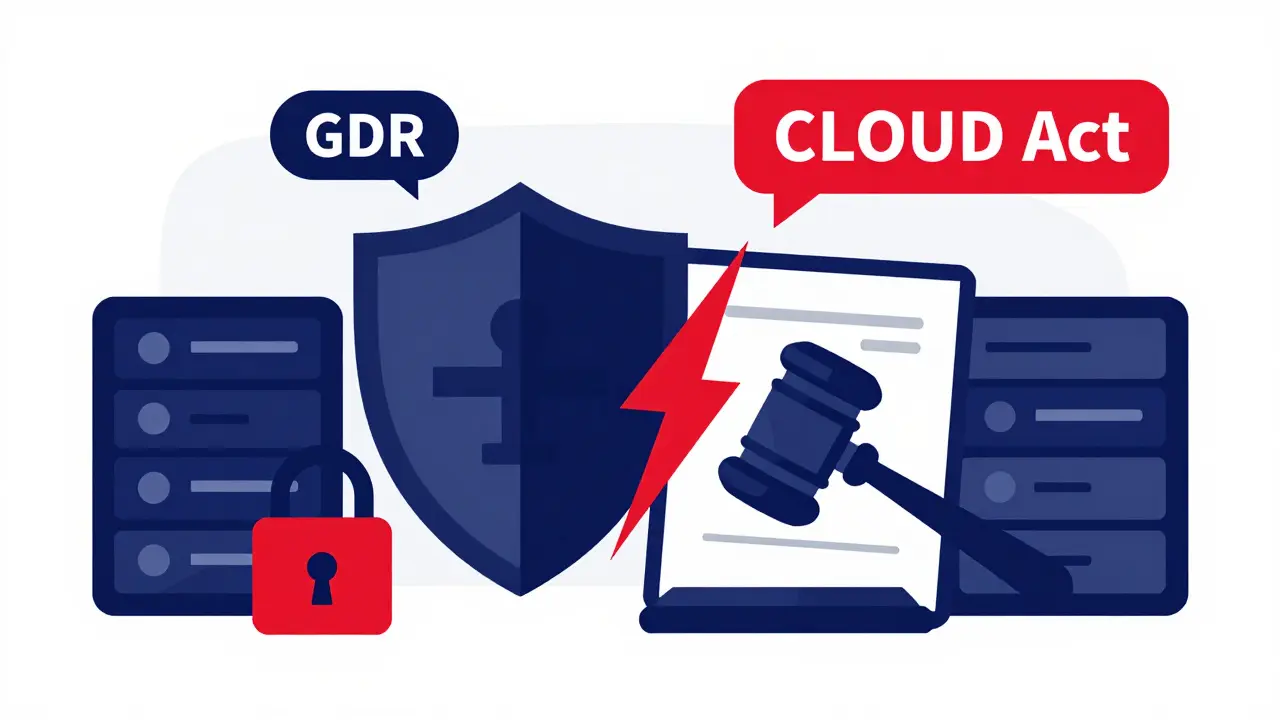
The issue isn't just about where the data ends up; it's about who can access it along the way. The CLOUD Act is a US federal law that requires tech companies to provide data stored overseas if requested by US authorities. in the United States, for example, allows US government agencies to compel US-based tech companies to hand over data regardless of where it is physically stored. This creates a direct conflict with GDPR principles, which prohibit transferring data to countries where surveillance laws undermine privacy rights. As of mid-2026, this tension remains unresolved, forcing companies to implement robust technical and contractual safeguards to bridge the gap.
Consider the Replika case from 2024. The US-based developer was fined €5 million by Italy’s data protection authority for deploying a generative AI chatbot in Europe without sufficient transparency or a valid legal basis. This wasn’t a minor oversight; it highlighted how AI services developed under one jurisdiction’s regulations can easily violate stricter privacy regimes abroad. If your company uses public AI tools, you need to ask: Do we know where our data goes? Can we control who sees it?
Understanding the Legal Framework for Transfers
To comply with GDPR when using generative AI, you must navigate Chapter V of the regulation, which governs international data transfers. The process involves two distinct stages. First, you must verify that the initial processing of data is lawful under Articles 6 and 9. This means having a valid legal basis such as consent, contractual necessity, or legitimate interest. Second, you must ensure the transfer mechanism itself complies with Chapter V requirements.
Here are the primary mechanisms available for transferring data outside the EEA:
- Adequacy Decisions: The European Commission determines that certain countries provide adequate data protection. As of 2025, only 16 countries hold this status, including Canada, Japan, New Zealand, Switzerland, and the United Kingdom. If your AI provider hosts data in one of these nations, the transfer is generally straightforward.
- Standard Contractual Clauses (SCCs): These are pre-approved contract terms between the data exporter and importer. They are the most common tool for transfers to non-adequate countries like the US. However, SCCs alone are often insufficient; you must also conduct a Transfer Impact Assessment (TIA) to evaluate local laws in the destination country.
- Binding Corporate Rules (BCRs): Internal policies for multinational groups that allow intra-company data transfers. BCRs are rigorous to obtain but provide long-term stability for large enterprises.
- Derogations under Article 49: Specific exceptions for individual transactions, such as explicit consent or necessity for contract performance. These are not suitable for systematic, large-scale AI processing.
The EDPB’s June 2025 guidelines clarified a critical point: judgments or decisions from third-country authorities cannot be automatically recognized in EU Member States. Furthermore, Article 6(1)(b) GDPR (contractual necessity) cannot serve as a legal basis for private entities to comply with third-country authority requests. This means you cannot simply argue that you transferred data because a foreign court ordered you to do so.
The Risk Landscape: Fines and Enforcement Trends
The stakes for non-compliance have never been higher. Regulators are increasingly targeting cross-border data flows in AI contexts, viewing them as high-risk areas for privacy violations. Since 2022, GDPR enforcement actions related to AI have increased by 320%, with cross-border transfer cases representing 64% of total AI enforcement actions in 2024, according to DLA Piper’s report.
| Company | Year | Fine Amount | Key Issue |
|---|---|---|---|
| Amazon | 2021 | €746 million | Privacy violations and lack of transparency in data collection |
| Replika | 2024 | €5 million | Deploying generative AI chatbot in Europe without sufficient legal basis |
| Meta | 2024 | €1.2 billion | Improper EU user data transfers to the US |
These fines are not just financial penalties; they signal regulatory intent. Meta’s record-breaking fine demonstrates that regulators are willing to impose maximum sanctions for systemic transfer violations. TrustArc’s 2025 research highlights that 40% of AI-related data breaches will result from generative AI misuse across borders by 2027, according to Gartner predictions. This growing risk disparity between regions underscores the urgency of proactive compliance.

Practical Steps for Compliance in 2026
Navigating this landscape requires more than just legal review; it demands operational changes. Here is a step-by-step approach to securing your generative AI deployments against cross-border risks.
- Map Your Data Flows: You cannot protect what you cannot see. Identify every instance where personal data enters an AI system. Determine who the data controller is, who the processors are, and where the data travels. Microsoft’s Public Sector guide notes that 68% of surveyed EU government agencies reported confusion about accountability in hybrid AI processing environments. Clarify roles early.
- Conduct Transfer Impact Assessments (TIAs): For every transfer to a non-adequate country, perform a TIA. Evaluate the local laws of the destination country. Do they allow government access to data? Are there safeguards in place? Document your findings thoroughly. The EDPB expects a case-by-case assessment, typically requiring 3-6 months of legal review and technical adjustments.
- Implement Technical Safeguards: Contracts alone are not enough. Use encryption both in transit and at rest. Apply pseudonymization to remove identifiable information before processing. Implement strict access controls based on least privilege principles. Consider privacy-enhancing technologies (PETs) like differential privacy or homomorphic encryption, especially for high-risk applications. By Q4 2025, 47% of enterprises were implementing PETs for AI workloads, though costs remain high for SMEs.
- Update Standard Contractual Clauses: Ensure your SCCs include specific addendums for AI processing. Address subprocessor visibility, data routing transparency, and model training data usage. Gartner projects that by 2027, 90% of large enterprises will implement AI-specific data transfer addendums to SCCs.
- Train Your Employees: Human error is a major vulnerability. ROUTE06’s 2025 case studies show that employees often lack awareness of where their data is being stored. Develop an AI acceptable use policy. Provide sanctioned tools and monitor for policy violations. Include quarterly refreshers and real-time monitoring capabilities to keep the policy effective.
The Role of the EU AI Act and Future Outlook
The regulatory landscape is evolving rapidly. The EU AI Act is comprehensive legislation regulating artificial intelligence systems in the European Union based on risk levels., expected to take full effect in Q3 2026, will introduce risk-based requirements for AI systems. High-risk applications will require enhanced data protection assessments, adding another layer of complexity to cross-border transfers.
Additionally, the convergence of GDPR enforcement with the Digital Services Act (DSA) is creating new enforcement opportunities. In late 2024, Berlin’s Data Protection Authority leveraged DSA Article 16 to request Apple and Google delist the DeepSeek app over alleged GDPR-breaching data transfers to China. This novel approach shows regulators are expanding their toolkit beyond traditional GDPR mechanisms.
Looking ahead, the Brussels Privacy Hub predicts a 75% increase in cross-border AI enforcement actions between 2025 and 2027. The European Commission is negotiating an updated EU-US Data Privacy Framework to replace the invalidated Privacy Shield, with completion expected by Q2 2026. While this may provide some relief for US-EU transfers, it will not eliminate the need for robust internal controls. Organizations must prepare for a future where transparency, accountability, and technical security are non-negotiable.
What is a third-country data transfer in the context of generative AI?
A third-country data transfer occurs when personal data collected in the European Economic Area (EEA) is sent to a country outside the EEA for processing. In generative AI, this often happens when users input data into AI models hosted on servers in non-adequate countries like the US or China. GDPR requires that such transfers maintain equivalent protection standards to those within the EU.
How do the EDPB Guidelines 02/2024 affect my company?
The EDPB Guidelines 02/2024 clarify that third-country authority requests cannot be automatically honored under GDPR. They emphasize the need for case-by-case assessments of international agreements and highlight the importance of transparency in AI supply chains. Companies must review their current transfer mechanisms and ensure they have documented impact assessments and technical safeguards in place.
Are Standard Contractual Clauses (SCCs) enough for AI data transfers?
No, SCCs alone are rarely sufficient. While they provide a contractual basis for transfer, you must also conduct a Transfer Impact Assessment (TIA) to evaluate the legal environment of the destination country. If local laws allow government access to data, you must implement additional technical measures like encryption or pseudonymization to ensure compliance.
What should I do if my AI provider does not disclose its subprocessors?
Opacity in subprocessor chains is a significant compliance risk. You should demand full disclosure of all subprocessors involved in data processing. If the provider refuses, consider switching to a more transparent vendor. Dr. Wojciech Wiewiórowski, European Data Protection Supervisor, has noted that lack of subprocessor visibility is one of the biggest challenges for AI compliance.
How does the CLOUD Act impact GDPR compliance?
The CLOUD Act allows US authorities to access data held by US companies, even if stored overseas. This conflicts with GDPR’s prohibition on transferring data to countries with inadequate privacy protections. To mitigate this risk, companies should use encryption where keys are held by the EU entity, limiting the ability of US authorities to access readable data.