Top Enterprise Use Cases for Large Language Models in 2025: A Practical Guide
 Jul, 6 2026
Remember when every company had a "chatbot" that just confused customers? That era is officially over. By 2025, the conversation shifted from "Can we build it?" to "How do we make money with it?" The hype cycle settled into hard reality. Organizations stopped playing with generic demos and started deploying Large Language Models (LLMs) advanced AI systems capable of understanding and generating human-like text for complex enterprise tasks that actually solve business problems.
The numbers don't lie. According to Red Hat's late 2024 analysis, 92% of organizations are doubling down on AI investments. Why? Because pilot programs showed operational costs dropping by up to 37% and decision-making speeds increasing by 80%. But here is the catch: success isn't about picking the biggest model. It’s about picking the right tool for the specific job. Whether you are looking to automate customer support or streamline legal review, knowing which LLM use case fits your infrastructure is the difference between a productivity boost and a security nightmare.
1. Intelligent Document Processing and Knowledge Retrieval
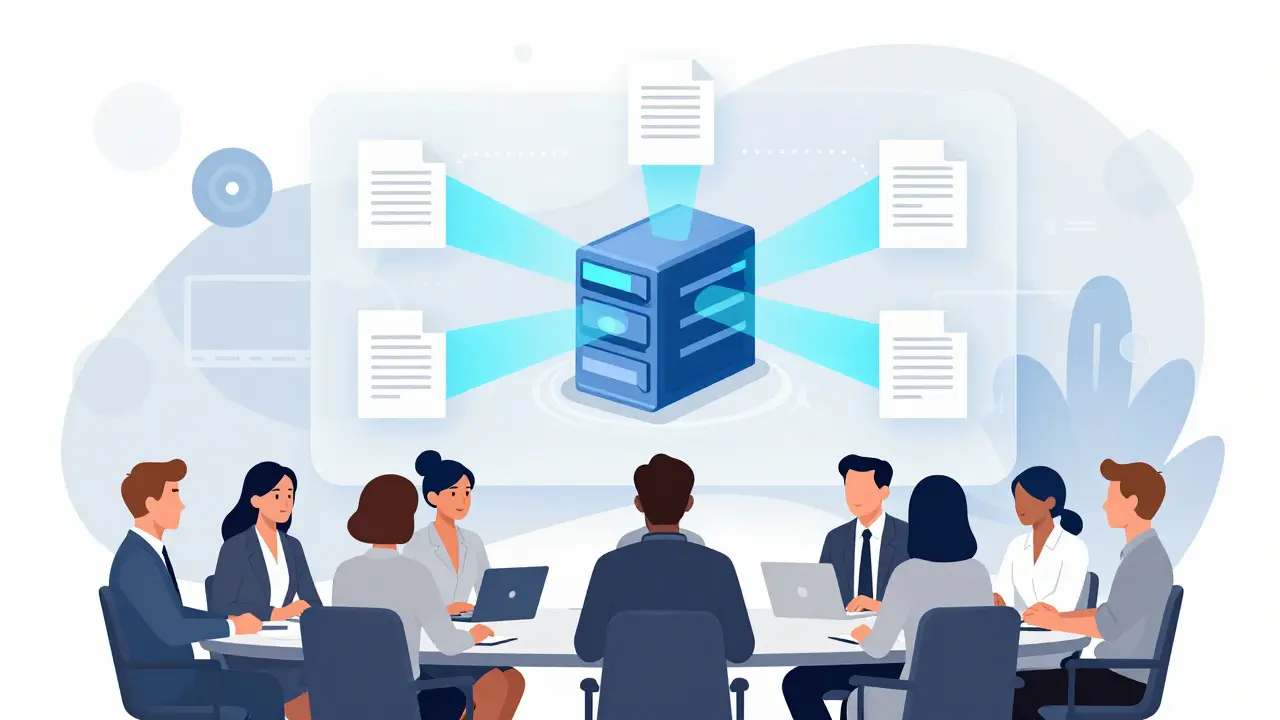
If your company deals with contracts, medical records, or compliance manuals, you are drowning in unstructured data. This type of data makes up 80-90% of all enterprise information, yet most companies leave it sitting in PDFs and Word docs. The top use case for 2025 is turning this chaos into searchable, actionable knowledge using Retrieval-Augmented Generation (RAG) a technique that connects LLMs to external databases to provide accurate, context-specific answers based on real company data.
Instead of relying on an LLM's general training data (which might be outdated or hallucinated), RAG pulls specific documents from your secure internal server before generating an answer. For example, a customer service agent can ask, "What is our return policy for damaged electronics purchased last month?" The system retrieves the exact policy document from Salesforce or SharePoint and gives a precise answer with citations. Gartner noted in early 2025 that companies without proper data governance saw accuracy drop within six months. The key is not just the model, but the quality of the data you feed it. Successful implementations require 3-6 months of data curation before launch. It sounds tedious, but it prevents the AI from making things up-a critical factor in regulated industries like finance and healthcare.
2. Hyper-Personalized Customer Experience
Gone are the days of "Hi, I am Dave, how can I help you?" Modern enterprises use LLMs to analyze customer sentiment in real-time across emails, chats, and social media. This goes beyond simple keyword matching. The AI understands nuance, sarcasm, and urgency.
Consider a retail scenario. A customer complains about a delayed shipment via Twitter. An LLM-powered system detects the frustration level, checks the order status in the backend, drafts a personalized apology with a discount code, and suggests the best time to contact the customer-all without human intervention. Companies using these tools reported customer satisfaction scores jumping by 18-29 points. However, the magic happens when the AI hands off to a human at the right moment. McKinsey found that "superagency" teams-where humans augment AI outputs rather than being replaced by them-achieved 3.2x higher productivity. The goal is seamless escalation, not full automation.
3. Code Generation and IT Operations Support
Code generation was the first breakout use case for enterprise AI, accounting for 28% of all implementations in 2025. Developers aren't just using Copilot-style assistants to write snippets; they are using LLMs to debug legacy code, write documentation, and even generate entire microservices.
But the bigger win is in IT operations. Imagine an IT ticket comes in: "The database connection timeout increased by 200ms." An LLM integrated with monitoring tools like Datadog or Splunk can analyze logs, correlate events, and suggest a fix or even execute a safe remediation script. This reduces mean time to resolution (MTTR) significantly. The challenge here is trust. Engineers need to verify every suggestion. That’s why closed-source models with high reliability ratings (92% uptime) are preferred over open-source alternatives in production environments, despite the latter offering more customization.
4. Risk Management and Fraud Detection
In finance, speed and accuracy are currency. Traditional rule-based fraud detection systems generated too many false positives, annoying legitimate customers. Fine-tuned LLMs changed the game. JPMorgan Chase, for instance, deployed fine-tuned models that achieved 94.7% detection accuracy with 38% fewer false positives.
How does it work? The LLM analyzes transaction patterns, user behavior history, and contextual data simultaneously. It doesn't just look for "large amount in unusual location." It understands that a user traveling internationally might legitimately spend money abroad. This nuanced understanding requires domain-specific fine-tuning. Generic models only hit 70-78% accuracy on such tasks, whereas tuned models reach 85-92%. For financial institutions, this margin of error is the difference between losing millions to fraud or losing customers to friction.
Choosing Between Large and Small Language Models
A major shift in 2025 is the rise of Small Language Models (SLMs) compact AI models with fewer parameters that offer faster performance and lower costs for specific tasks. You don't always need a massive 175-billion-parameter model to summarize an email. SLMs, like Mistral 7B or IBM's Granite series, now represent 41% of new enterprise deployments. They require only 16-24GB of VRAM, meaning they can run on standard enterprise servers rather than expensive GPU clusters.
| Feature | Large Language Models (LLMs) | Small Language Models (SLMs) |
|---|---|---|
| Accuracy on Domain Tasks | 85-92% (after fine-tuning) | 80-89% (within 3-5 points of LLMs) |
| Hardware Requirements | High-end GPUs, significant VRAM | Standard servers, 16-24GB VRAM |
| Cost Efficiency | Higher inference costs per token | 60-75% less computational resources |
| Best Use Case | Complex reasoning, creative generation | Classification, summarization, specific workflows |
| Deployment Speed | Slower due to infrastructure needs | Faster, easier integration |
If your task is straightforward-like categorizing support tickets or extracting dates from invoices-an SLM is cheaper, faster, and often more private because it can run entirely on-premise. Anthropic and OpenAI still lead in market share for complex reasoning tasks, but for routine automation, smaller models are winning.
Security, Compliance, and Vendor Lock-in
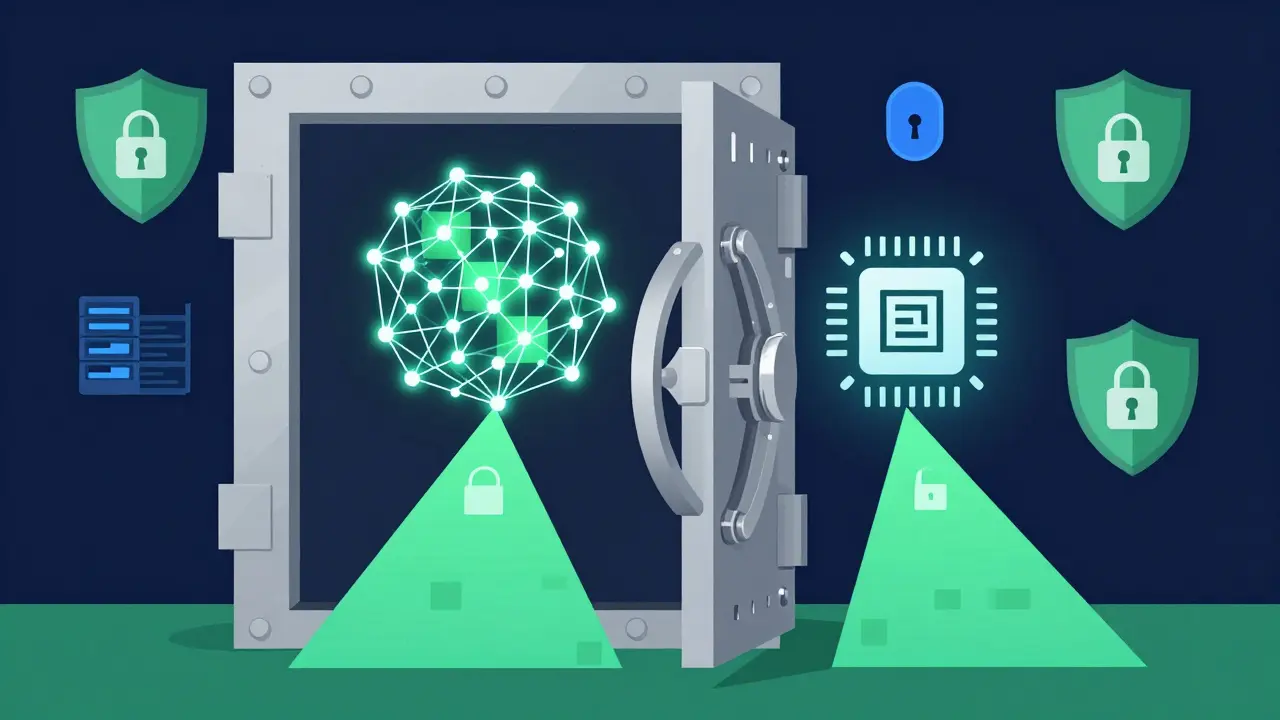
You cannot talk about enterprise AI without talking about risk. In 2025, 94% of financial and healthcare firms mandate on-premise or private cloud deployment. Sending sensitive patient data or trade secrets to a public API is a non-starter. SOC 2 Type II compliance is no longer optional; it's table stakes.
Vendor lock-in is another headache. If you build everything on one provider's proprietary API, you are at their mercy if prices spike or services degrade. Smart enterprises are adopting multi-vendor strategies. They might use Google's models for search-related tasks, Anthropic for complex reasoning, and an open-source SLM for internal document processing. This diversification mitigates risk and ensures business continuity. Remember, 65% of enterprises implementing LLMs without a clear data governance framework faced accuracy issues. Security isn't just about firewalls; it's about controlling who sees what data and ensuring the AI doesn't leak it.
Implementation Roadmap: From Pilot to Production
So, how do you start? Don't boil the ocean. Pick one high-value, low-risk process. Here is a practical checklist:
- Define the Metric: Are you measuring cost savings, speed, or accuracy? Set a baseline.
- Clean Your Data: Garbage in, garbage out. Spend those 3-6 months curating your knowledge base.
- Choose the Right Model Size: Start with an SLM if possible. Scale up only if necessary.
- Implement Human-in-the-Loop: Especially for customer-facing apps, ensure a human can override or correct the AI.
- Monitor Continuously: Track hallucination rates and latency. Accuracy degrades over time as data changes.
Expect a learning curve. MIT Sloan notes that basic RAG implementations can go live in 4-8 weeks, but specialized fine-tuning takes 14-22 weeks. Invest in training your team. Prompt engineering is now a core skill, required in 87% of implementations. Business analysts, not just data scientists, need to understand how to interact with these models effectively.
Is it better to use open-source or proprietary LLMs for enterprise?
It depends on your priority. Proprietary models (like those from Anthropic or OpenAI) offer better support, higher reliability (92% uptime), and easier integration with platforms like Microsoft 365. Open-source models provide greater customization and avoid vendor lock-in but require more technical expertise to maintain and often have lower out-of-the-box accuracy. In 2025, 41% of new deployments chose Small Language Models (often open-source) for cost and privacy reasons.
How long does it take to implement an LLM solution?
Simple Retrieval-Augmented Generation (RAG) systems can be deployed in 4-8 weeks. However, domain-specific fine-tuning for complex tasks like healthcare diagnostics or legal analysis typically requires 14-22 weeks. Most organizations underestimate data preparation, which alone can take 3-6 months.
What are the biggest risks of using LLMs in 2025?
The primary risks are data privacy breaches, hallucinations (inaccurate information), and vendor lock-in. To mitigate these, use on-premise or private cloud deployments for sensitive data, implement human-in-the-loop verification for critical outputs, and adopt a multi-vendor strategy to avoid dependency on a single provider.
Do I need a PhD in AI to use LLMs in my company?
Not necessarily. While deep customization requires AI engineers, basic implementations like RAG or prompt-engineered workflows can be managed by business analysts with 2-3 weeks of training. The barrier to entry has lowered significantly, though data engineering skills remain crucial for success.
Which industries are seeing the highest ROI from LLMs?
Finance, healthcare, and retail are leading adoption rates. Finance benefits from fraud detection and compliance automation. Healthcare gains from administrative efficiency and diagnostic support. Retail sees improvements in personalized customer experience and supply chain optimization.
michael rome
July 8, 2026 AT 00:46It is genuinely inspiring to see the industry finally moving past the novelty phase and focusing on tangible business value. The emphasis on data curation before deployment is a crucial point that many organizations overlook in their haste to innovate. We must ensure that our teams are adequately trained to handle these new tools responsibly.
Andrea Alonzo
July 8, 2026 AT 22:16I have been observing the shift towards Small Language Models with great interest, particularly because it allows for more inclusive access to AI technologies without requiring massive computational resources that only large corporations can afford, and I believe this democratization of technology is essential for fostering innovation across various sectors including small businesses and non-profits who might otherwise be left behind in the digital transformation race.
Saranya M.L.
July 9, 2026 AT 21:22The assertion that RAG implementations require merely three to six months of data curation is fundamentally flawed when considering the ontological complexity inherent in enterprise knowledge graphs, as the semantic interoperability issues between disparate legacy systems necessitate a far more rigorous metadata enrichment process than suggested by such superficial timelines, thereby rendering the proposed ROI projections statistically insignificant for mid-sized enterprises lacking dedicated data engineering squads.
om gman
July 11, 2026 AT 18:38oh wow another article telling us what we already know about llms being useful but also risky how original i mean really do you think anyone here doesnt know about vendor lock-in or hallucinations its like explaining gravity to astronauts so tedious
Jeanne Abrahams
July 12, 2026 AT 15:57In South Africa, we are seeing a very different reality where infrastructure constraints make the 'standard enterprise server' recommendation laughable for many local firms, forcing us to rely heavily on cloud APIs despite the privacy concerns, which makes the push for on-premise SLMs feel like a luxury problem rather than a practical solution for emerging markets.