Vibe Coding Economics: Cost Curves, Risks, and Competitive Shifts in 2026
 Jul, 16 2026
Software used to be expensive. Building a simple internal tool could cost tens of thousands of dollars and take months. Today, that same tool might cost you nothing but a few hours of your time and a subscription fee. This shift isn't just about speed; it's about a fundamental rewrite of the economic rules governing how we build digital products. We call this era "vibe coding," a term that has moved from niche tech blogs to boardroom discussions as large language models (LLMs) matured into reliable code generators.
But here is the catch: while the upfront cost of building software has plummeted, the long-term financial picture is far more complex. You are trading high initial labor costs for potential hidden maintenance nightmares. As we navigate through 2026, understanding these cost curves and competitive dynamics is no longer optional-it’s essential for any business leader or developer looking to stay relevant.
The New Cost Curve: Cheap Start, Expensive Scale?
To understand the economics of vibe coding, you have to look at the shape of the cost curve. In traditional software development, the curve starts high. You hire developers, pay for architecture planning, and spend weeks on setup. The initial investment is steep. With vibe coding, that initial hill is gone. Platforms like Google Firebase Studio and Microsoft GitHub Copilot allow you to generate a functional Minimum Viable Product (MVP) in minutes rather than weeks.
Data from Tanium’s 2024 case studies shows an estimated 60-80% reduction in initial development costs for MVPs. If you need a prototype to test an idea, vibe coding is economically unbeatable. Microsoft’s internal testing confirmed this, showing prototype times dropping from 40+ hours to under five minutes for simple apps.
However, the curve changes after launch. Traditional development has a relatively flat maintenance curve if the architecture is sound. Vibe coding often introduces a rising maintenance curve. Why? Because AI-generated code prioritizes immediate functionality over long-term structural integrity. Without human oversight, the code can become messy, hard to read, and difficult to scale. Forrester Research warned in late 2024 that maintenance costs for vibe-coded apps can be 20-30% higher than traditionally developed ones after the first year if proper governance isn’t applied.
| Metric | Traditional Development | Vibe Coding (AI-Assisted) |
|---|---|---|
| Initial MVP Cost | $15,000 - $50,000+ | $0 - $2,000 (mostly tooling/training) |
| Time to Prototype | Weeks to Months | Hours to Days |
| Year 1 Maintenance | Stable (if well-architected) | Variable (risk of technical debt) |
| Long-Term Scalability | High (with proper design) | Low to Medium (without refactoring) |
| Human Skill Requirement | Senior Developers ($150-$250/hr) | Prompt Engineers / Business Analysts ($85-$120/hr) |
Competitive Dynamics: Who Wins the Market?
The rise of vibe coding has reshaped the competitive landscape. It’s not just a battle between coding languages anymore; it’s a war for user attention and ease of use. Three distinct segments have emerged by mid-2026.
First, there are the no-code/low-code platforms targeting business users. Companies like Knack and Google Firebase Studio dominate here, holding about 35% of the market share according to IDC’s Q1 2025 report. These tools empower non-technical staff to build their own solutions. Second, AI pair programmers like GitHub Copilot serve professional developers, capturing 50% of the market. They don’t replace the coder; they make them faster. Finally, specialized vertical solutions hold the remaining 15%, focusing on niche industries with specific compliance needs.
This fragmentation creates a unique dynamic. Microsoft leads with 32% market share through its deep integration of Copilot into existing workflows. Google follows closely with 28%, leveraging Firebase Studio. But the real competition isn’t just between these giants; it’s between the model of "build it yourself" versus "buy it pre-built." Vibe coding lowers the barrier to entry so much that custom software is becoming a commodity. Goldman Sachs predicts vibe coding will capture 35-40% of the $520 billion custom software market by 2028. That means if you’re selling generic software, you’re now competing against every marketing manager who can prompt an AI to build a better version for free.
The Hidden Danger: Technical Debt on Steroids
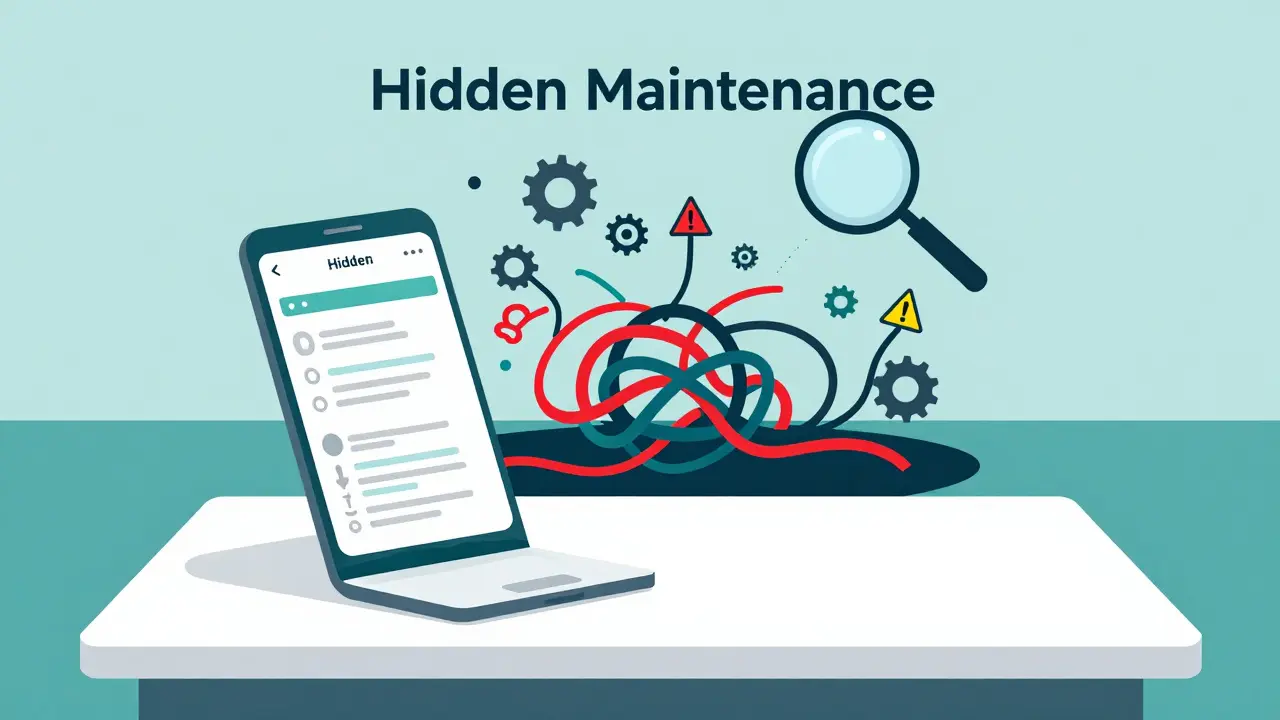
Let’s talk about the elephant in the room: technical debt. In traditional coding, technical debt accumulates slowly. In vibe coding, it can accumulate instantly. When an AI generates code based on a natural language prompt, it makes assumptions. It might choose a library that is deprecated, write inefficient loops, or create security vulnerabilities because it didn’t understand the broader context of your application.
Gartner analyst Mark Minevich warned in early 2025 that the total cost of ownership for vibe-coded applications could exceed traditional development after 18-24 months without strict governance. Morgan Stanley estimates that unaddressed architectural issues in early vibe-coded apps could generate $120-$180 billion in remediation costs industry-wide between 2026 and 2028. That is a massive number. It suggests that while we are saving money today, we might be borrowing heavily from our future selves.
Consider the story of RouteOptimize, a logistics startup covered by TechCrunch in August 2024. They used vibe coding to build their initial platform quickly. It worked great for six months. Then, as they scaled, the underlying code structure couldn’t handle the load. They ended up spending $200,000 to refactor the entire system-money they thought they had saved. Contrast this with PixelPulse, a marketing agency that successfully used Knack’s vibe coding features to reduce tool development costs by 90%. The difference? PixelPulse had technical oversight. They treated the AI output as a draft, not a final product.
Shifting Skills and Workforce Economics
If coding is easier, do we still need developers? Yes, but their role is changing. The demand for junior coders who only know syntax is dropping. The demand for "prompt engineers" and business analysts who understand logic and architecture is skyrocketing. Upwork’s Q4 2024 data shows prompt engineering skills valued at $85-$120 per hour.
Microsoft’s 2024 study found that non-technical users need only 8-12 hours of training to become proficient with vibe coding tools, compared to 40+ hours for traditional no-code platforms. This democratization of development means companies can onboard talent faster and cheaper. However, it also means that everyone is a builder. Your HR department might build a recruiting app. Your finance team might build a budget tracker. This decentralization is efficient but risky. Without centralized standards, you end up with a fragmented IT ecosystem where no one knows how all the pieces fit together.

Regulatory Headwinds and Compliance Costs
Economics doesn’t exist in a vacuum. Regulation plays a huge role. The EU’s AI Act, effective January 2025, requires documentation of AI-generated code for critical infrastructure applications. PwC estimates this adds 5-7% to development costs. In the US, while federal regulation is slower, corporate liability concerns are driving similar internal policies.
If your AI-generated code fails and causes a data breach, who is liable? The company? The developer who prompted it? The AI provider? Currently, the answer is usually the company. This legal ambiguity adds a layer of risk cost that businesses must factor into their budgets. Insurance premiums for cyber liability may rise as insurers recognize the unpredictability of AI-generated codebases.
Strategic Recommendations for 2026 and Beyond
So, how do you navigate this new economic reality? Here are three practical steps:
- Adopt a Hybrid Model: Use vibe coding for frontend interfaces, internal tools, and rapid prototyping. Reserve traditional development for core infrastructure, high-security modules, and complex backend logic. This balances speed with stability.
- Implement Governance Early: Don’t wait until you have technical debt. Establish code review processes even for AI-generated code. Require architects to sign off on major components. Deloitte’s 2024 guide emphasizes that strict governance frameworks are the key to long-term viability.
- Budget for Refactoring: Accept that vibe-coded apps will likely need significant updates within 12-18 months. Allocate 15-20% of your annual IT budget specifically for maintaining and refactoring AI-assisted projects.
The era of vibe coding is here. It offers unprecedented speed and cost savings, but it demands a new kind of discipline. The companies that win won’t be those that just use AI to code faster; they’ll be the ones that manage the resulting complexity wisely.
Is vibe coding replacing professional developers?
Not entirely, but it is changing their role. Professional developers are shifting from writing boilerplate code to architecting systems, reviewing AI output, and handling complex logic that AI struggles with. The demand for pure syntax knowledge is decreasing, while the value of architectural oversight and prompt engineering is increasing.
What are the biggest risks of using vibe coding for enterprise software?
The primary risks are technical debt accumulation, security vulnerabilities due to lack of context awareness, and scalability issues. AI models may generate code that works initially but fails under heavy load or becomes unmaintainable over time. Without proper governance, remediation costs can exceed initial savings significantly.
How much does vibe coding actually save in costs?
For initial MVPs and prototypes, savings can range from 60% to 80% compared to traditional development. However, these savings can erode over time if maintenance costs rise due to poor code quality. Long-term total cost of ownership depends heavily on implementation strategy and governance.
Which platforms are leading the vibe coding market in 2026?
Microsoft leads with approximately 32% market share through GitHub Copilot, followed by Google with 28% via Firebase Studio. Specialized platforms like Knack hold around 15% in the business user segment. The market is dominated by major tech players integrating AI directly into existing development environments.
Do I need special skills to use vibe coding effectively?
You need strong logical thinking and domain expertise rather than traditional programming syntax skills. Prompt engineering is crucial-you must know how to describe requirements clearly. Additionally, understanding basic software architecture helps prevent common pitfalls like scope creep and poor data modeling.