Vibe Coding Limitations: What AI-Generated Code Still Struggles to Deliver
 Jul, 13 2026
It feels like magic until it doesn't. You type a prompt into an AI assistant, describe the app you want in plain English, and watch as lines of code appear on your screen. This is vibe coding, defined as a software development approach where natural language instructions replace manual coding to generate applications via AI assistants. In early 2025, this method promised to democratize software creation, allowing non-technical users to build apps without learning syntax. But as we move through 2026, the honeymoon phase is over. The reality is that while vibe coding is fantastic for quick prototypes, it hits a hard wall when you try to turn those prototypes into real, secure, scalable products.
If you have tried building more than a simple landing page or a basic calculator using these tools, you likely already know the pain points. The code looks good, but something feels off. Bugs appear out of nowhere. Security holes yawn wide open. And when you try to add one small feature, half the app breaks. Let’s look at exactly why AI-generated code still struggles to deliver what traditional engineering does, and where the real limits lie.
The Three-Month Wall: When Context Windows Fail
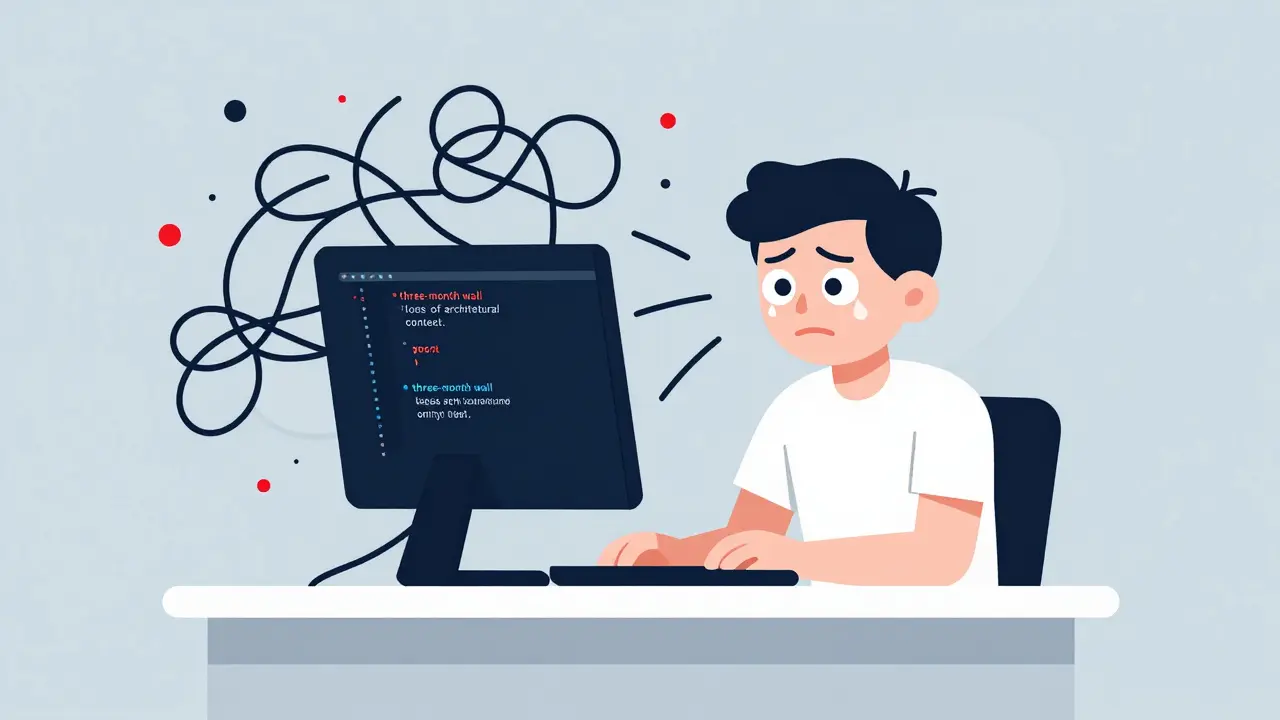
One of the most consistent findings from developers who adopted vibe coding in 2025 is the "three-month wall." Early on, everything works smoothly. You can build features quickly, and the AI handles the structure. But as the project grows, so does the complexity. By month three, the codebase often becomes too large for the AI’s context window to handle effectively.
Think about how humans read code. We don’t read every line; we understand the architecture. We know which files talk to which databases and why certain patterns were chosen. AI systems, however, rely on token limits. When your project exceeds those limits, the AI can only see fragments of your system. It loses the "big picture." According to analysis by Red Hat Developer, this leads to a state where no one-not even the original builder-can fully comprehend the system holistically. You lose the mental map. Without that map, navigating back to stable versions when things break becomes nearly impossible.
This isn’t just a theoretical issue. It’s a structural limitation of current Large Language Models (LLMs). They are great at generating snippets but terrible at maintaining long-term architectural coherence across thousands of lines of interdependent code. If your goal is a hobby project that stays small, you might never hit this wall. But if you aim for a production-grade application, you will eventually need human engineers to step in and restructure the mess.
Whack-a-Mole: The Iterative Development Trap
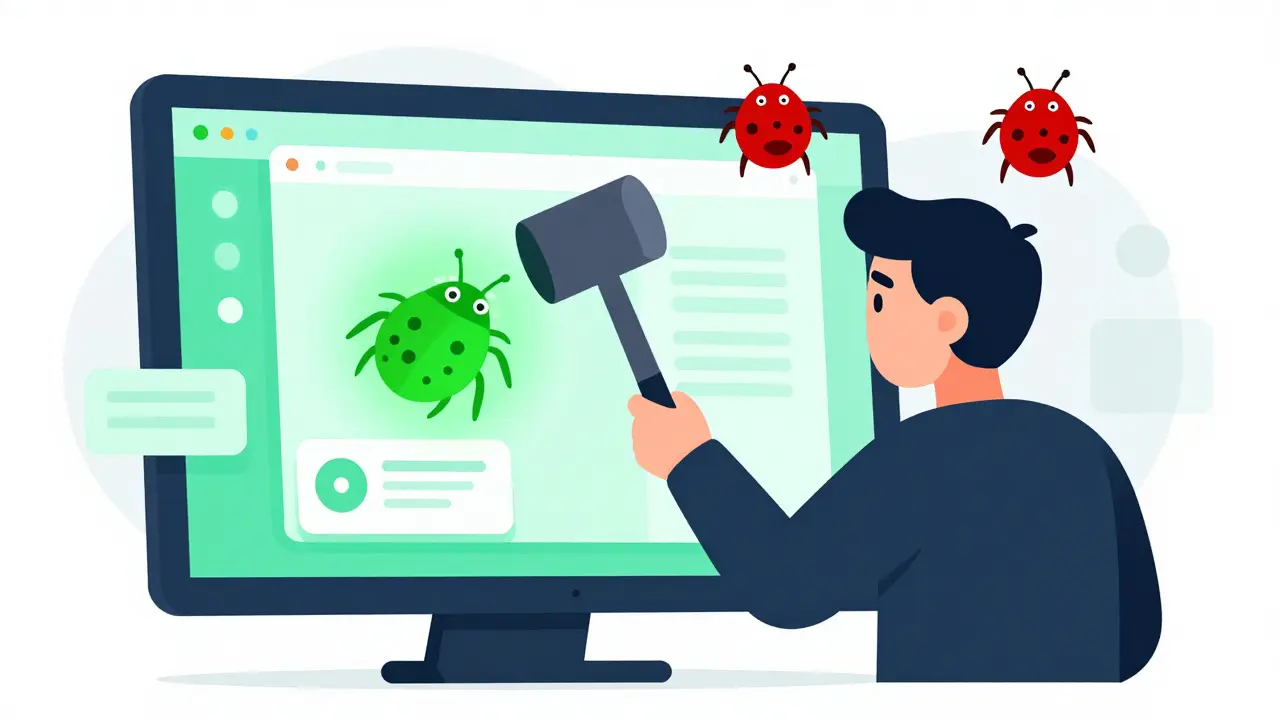
Have you ever fixed one bug, only to have three new ones appear? In vibe coding, this happens constantly. Developers call it the "whack-a-mole" problem. Because there are no strict specifications or guardrails, the AI interprets broad prompts loosely. When you ask it to change a button color or update a login flow, it doesn’t just change that specific part. It updates related components automatically, often making assumptions that break other features.
The root cause here is the loss of intent. In traditional development, we write comments and documentation to explain *why* code exists. In vibe coding, the code itself is the only source of truth. But code is bad at explaining intent. Once the initial generation happens, the reasoning behind architectural decisions fades away. The AI doesn’t remember why it chose a specific database schema or why a certain function was structured a particular way. So, when you ask for a change, it guesses. And its guesses are often wrong.
This creates a fragile ecosystem. One vague prompt can shift the entire direction of a build. Users report experiencing "functionality flickering," where visual elements like button colors or layout structures change unpredictably between builds because the AI fills in unspecified design details differently each time. It’s disorienting and makes consistent development nearly impossible without rigorous testing protocols that most casual users don’t have.
| Feature | Vibe Coding | Traditional Development |
|---|---|---|
| Architectural Control | Limited; AI auto-selects patterns | High; Engineers design custom structures |
| Maintainability | Low; Intent is lost after generation | High; Documented specs and comments |
| Security | Weak; ~48% contains vulnerabilities | Strong; Peer reviews and audits |
| Scalability | Poor beyond prototype stage | Excellent with proper planning |
| Debugging | Hard; Opaque reasoning paths | Easier; Traceable logic flows |
Security Nightmares: The Hidden Cost of Convenience
Perhaps the most dangerous limitation of vibe coding is security. A 2025 report by Veracode found that nearly half of all AI-generated code contains security vulnerabilities. That number is staggering. But it gets worse. Most people using vibe coding are not security experts. They are entrepreneurs, marketers, or hobbyists who want to build an app quickly. They don’t know how to configure runtime environments securely. They rely on the AI to tell them how to set up their server, and the AI often gives generic, insecure advice.
Consider this scenario: You ask the AI to build a user login system. It generates code that stores passwords in plain text or uses weak hashing algorithms because it prioritizes speed over security. You, trusting the AI, deploy it. Now your users’ data is exposed. Unlike professional developers who undergo security training and follow best practices like OWASP guidelines, vibe coders lack the expertise to identify these risks. The tools themselves do not have robust security measures baked in by default. They produce code that platform teams cannot easily govern or secure.
This creates a massive liability for businesses. Enterprise environments frequently encounter "shadow IT" challenges where vibe-coded applications bypass standard security protocols. These apps often require significant reworking before they can be deployed with real customer data. For consumer products, this means guardrails must be built into the platform itself, rather than relying on the user to implement optional security features. Until then, vibe-coded apps remain risky bets for any sensitive data.
Scalability and Performance Constraints
Vibe coding shines when building simple applications. A portfolio site, a basic blog, or a single-page calculator? No problem. But scale changes everything. Large-scale applications with heavy traffic, complex integrations, or advanced security requirements consistently exceed the capabilities of AI-generated code. The AI struggles with performance optimization. It doesn’t know how to index a database efficiently for millions of records or how to cache API responses to reduce load times.
Performance issues aren’t just about speed; they’re about cost. Poorly optimized code consumes more server resources, leading to higher hosting bills. More importantly, it degrades user experience. If your app loads slowly or crashes under peak traffic, users leave. Vibe-coded apps often lack the fine-tuned efficiency that human engineers provide. They work, but they don’t work well at scale. This forces many projects to pivot back to traditional development methods once they gain traction, resulting in wasted time and money during the initial vibe-coding phase.

Domain-Specific Complexity: Where General Knowledge Fails
AI models are trained on general internet data. They know common patterns, popular frameworks, and standard business logic. But they struggle with niche domains. If you’re building an app for healthcare compliance, financial trading algorithms, or specialized manufacturing workflows, vibe coding falls short. These fields require deep domain expertise, not just coding skills. The AI misinterprets user intent when faced with unusual data models or rare algorithms.
For example, Stack Overflow documented a case where a bathroom review app generated error messages in red text about location services being unavailable. The interface looked complete, but core functionality was broken because the AI didn’t understand the specific permissions required for geolocation in that context. This highlights a critical gap: vibe coding cannot replace specialized knowledge. It can help explore ideas, but it cannot validate complex domain-specific rules without expert oversight.
How to Use Vibe Coding Effectively
Does this mean you should stop using AI for coding? Absolutely not. Vibe coding is a powerful tool for rapid prototyping and exploring ideas. The key is knowing its limits. Here’s how to use it effectively:
- Stick to Unit-Level Tasks: Use AI to generate small, isolated functions that can be tested independently. Avoid letting it build entire systems from scratch.
- Be Specific: Vague prompts lead to vague results. Provide clear constraints, expected inputs, and desired outputs. Specificity is king.
- Review Everything: Never trust AI-generated code blindly. Audit it for security vulnerabilities, performance bottlenecks, and logical errors.
- Plan Your Architecture First: Define your system’s structure before asking the AI to write code. This gives you a roadmap to keep the AI on track.
- Involve Human Experts: For anything beyond a prototype, bring in experienced developers to review and refine the codebase.
By treating vibe coding as a collaborative partner rather than a replacement, you can harness its speed while mitigating its risks. The future of software development isn’t purely human or purely AI-it’s a hybrid approach where humans provide the vision and oversight, and AI handles the repetitive heavy lifting.
What is the biggest risk of vibe coding?
The biggest risk is security vulnerabilities. Nearly half of AI-generated code contains flaws, and non-technical users often lack the expertise to identify or fix them, leaving applications exposed to attacks.
Why does vibe coding fail after three months?
Projects hit a "context wall" where the codebase becomes too large for the AI to process holistically. The AI loses track of the overall architecture, leading to inconsistent updates and unmanageable complexity.
Can vibe coding replace junior developers?
Not entirely. While it can handle basic tasks, it lacks the judgment, domain expertise, and architectural oversight that even junior developers provide. It is better suited as a productivity tool than a replacement.
Is vibe coding safe for enterprise applications?
Currently, no. Enterprise apps require strict governance, security audits, and scalability planning. Vibe-coded apps often create "shadow IT" challenges and require significant rework before production deployment.
How can I avoid the "whack-a-mole" bug cycle?
Use vibe coding only for unit-level tasks that can be tested in isolation. Maintain clear specifications and involve human engineers to review changes, ensuring that updates don’t inadvertently break other parts of the system.