Vision-Language Transformers: How Unified Models Bridge Images and Text
 Jun, 21 2026
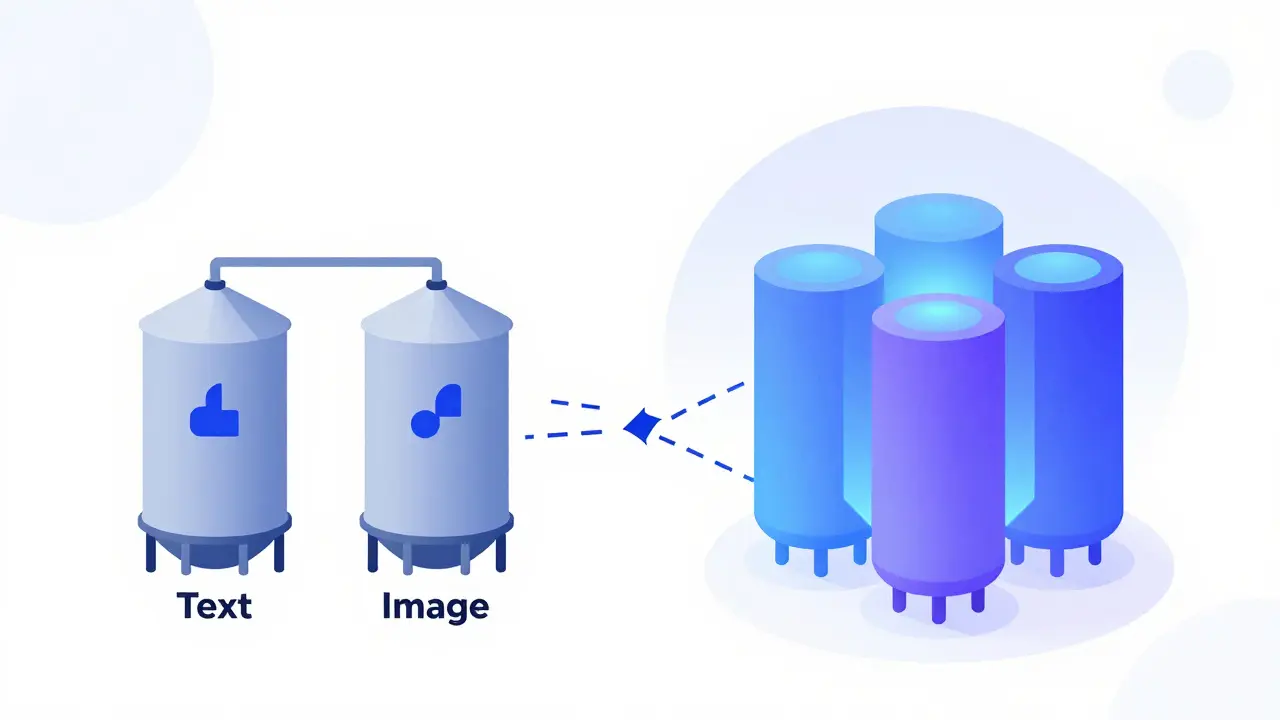
For years, artificial intelligence lived in silos. You had one model to read your emails and a completely different one to recognize faces in photos. They didn't talk to each other. They couldn't understand that the word "red" describes the color of the car in the picture you just uploaded. That separation is ending. Enter Vision-Language Transformers, the architectural shift that finally lets machines see and speak with the same brain.
We are no longer building separate tools for vision and language. We are building unified systems. These models treat images and text as the same kind of data-sequences of tokens. By doing so, they unlock bidirectional capabilities: describing an image in words or creating an image from a sentence, all within a single framework. This isn't just a technical tweak; it’s a fundamental change in how we design intelligent systems.
The Core Shift: From Separate Streams to Unified Tokens
To understand why Vision-Language Transformers matter, you have to look at what came before. Early multimodal models, like VilBERT, used a dual-stream approach. Imagine two workers sitting at a desk. One worker reads the text, the other looks at the image. They occasionally shout notes across the table to coordinate (a process called co-attention). It works, but it’s clunky. The workers never truly share the same mental map.
Vision-Language Transformers change this by flattening everything into sequences. In this architecture, an image is broken down into patches, which are then converted into vectors similar to how words become embeddings in large language models. Text is tokenized as usual. Both streams enter the same transformer layers. The attention mechanism-the part of the model that decides what information is important-operates on both visual and textual tokens simultaneously.
This unification allows for bidirectional generation. Because the model sees both modalities as part of the same sequence space, it can mask out parts of the input and predict them. If you mask the text, it generates a caption. If you mask the image tokens, it generates pixels. This symmetry is the key innovation driving modern multimodal learning.
How the Architecture Actually Works
Let’s strip away the jargon and look at the mechanics. A typical Vision-Language Transformer relies on three main components working in harmony:
- The Image Encoder: This component takes raw pixel data and converts it into meaningful features. Unlike older methods that relied on object detectors (like Faster R-CNN) to find bounding boxes first, modern encoders often use patch-based processing. They split the image into small squares, much like pixels, and embed each square into a vector space.
- The Text Encoder: This processes natural language inputs, converting words into semantic representations. In unified models, this is often a standard transformer encoder or decoder layer shared with the visual path.
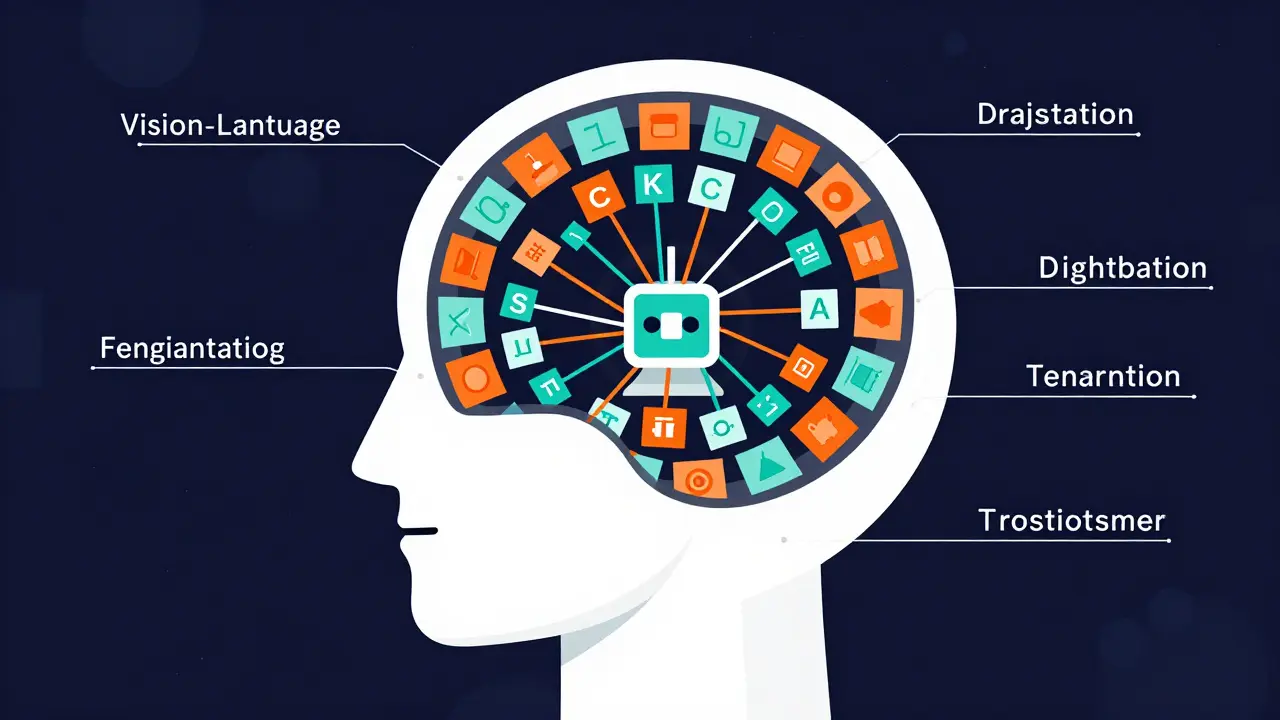
- The Fusion Mechanism: This is where the magic happens. Instead of merging features late in the process, fusion happens early and continuously through cross-attention. Every text token attends to every image token, and vice versa. This creates a rich, contextualized representation where the concept of "dog" in the text is directly linked to the visual features of fur and ears in the image.
Researchers at Sun Yat-sen University highlighted this approach in their work on unified generative frameworks. They demonstrated that preprocessing image-text pairs into mixed sequences allows the transformer to learn joint representations more efficiently than parallel streams. The model doesn't just associate concepts; it understands the structural relationship between them.
Key Players: VL-T5 and Beyond
You might be wondering if there is a specific model you should know. While many variations exist, VL-T5 is a prominent example of a unified vision-language model that leverages text prefixes to handle multiple tasks within a single architecture. Built on the T5 (Text-To-Text Transfer Transformer) foundation, VL-T5 treats every vision-language task as a text-to-text problem.
How does it do that? It uses special prefix tokens. For image captioning, the input might start with a prefix like "image_to_text:" followed by the image tokens. For visual question answering, the prefix changes to "vqa:". This elegant trick means you don’t need to train five different models for five different tasks. You train one robust transformer that learns to switch modes based on the prompt.
This contrasts sharply with earlier specialized models. Before this unified era, if you wanted to improve image search, you trained a retrieval model. If you wanted better captions, you trained a captioning model. Now, improvements in the core transformer benefit all downstream tasks simultaneously because they share the same underlying weights.
| Architecture Type | Fusion Strategy | Efficiency | Best Use Case |
|---|---|---|---|
| Dual-Stream (e.g., VilBERT) | Co-attention between separate encoders | High computational cost due to duplicate backbones | Specific detection tasks requiring distinct feature extraction |
| Unified Transformer (e.g., VL-T5) | Shared attention over mixed token sequences | Higher efficiency; single model handles multiple tasks | Bidirectional generation (text-to-image, image-to-text) |
| Hybrid Models | Combines early fusion with late alignment | Moderate; balances depth and speed | Complex reasoning tasks requiring deep visual analysis |
Real-World Applications: Beyond the Hype
Theoretical elegance is nice, but does it work in practice? The performance gains suggest yes. Studies on unified multimodal transformers have reported improvements ranging from 100.9% to 122.6% on image-to-text generation benchmarks like MS-COCO compared to prior approaches. That is not a marginal gain; it is a doubling of effectiveness.
Here is where this technology is landing today:
- Text-to-Image Generation: This is the most visible application. When you type "a cyberpunk cat wearing sunglasses" into a generator, a Vision-Language Transformer interprets the semantic meaning of "cyberpunk," "cat," and "sunglasses" and aligns them with visual features. It doesn't just paste a cat onto a neon background; it understands lighting, texture, and composition based on the linguistic context.
- Automated Image Captioning: Beyond simple descriptions, these models generate contextual narratives. For visually impaired users, this means richer audio descriptions of scenes. For social media platforms, it means automatic, accurate alt-text generation that improves accessibility and SEO.
- Visual Question Answering (VQA): You can upload a screenshot of a graph and ask, "What was the revenue in Q3?" The model reads the text labels, analyzes the visual bars, and synthesizes an answer. This bridges the gap between data visualization and human inquiry.
- Semantic Image Search: Forget keyword matching. You can search for "a cozy living room with warm lighting" and get results that match the vibe, not just the furniture tags. The model understands the abstract concept of "cozy" through its visual training.

Challenges and Limitations
It’s not all smooth sailing. Unifying modalities introduces significant complexity. The primary challenge is modality alignment. Getting the model to correctly map the word "blue" to the specific hex code range of blue in an image requires massive amounts of paired data. If the alignment is off, the model hallucinates-it describes objects that aren't there or generates images that contradict the text.
Another hurdle is computational cost. Processing high-resolution images as sequences of tokens requires immense memory. An image split into 196 patches (a common resolution for ViTs) already adds significant length to the input sequence. When you combine this with long text prompts, the quadratic complexity of the attention mechanism becomes a bottleneck. Researchers are actively working on sparse attention mechanisms and efficient token pruning to mitigate this.
Data bias is also a critical concern. Since these models are trained on web-scraped image-text pairs, they inherit societal biases present in those datasets. If certain demographics are underrepresented in the training data, the model will struggle to generate or recognize them accurately. Addressing this requires careful curation of training sets and ongoing audits of model outputs.
The Future of Multimodal Learning
We are moving toward a future where "multimodal" is the default, not an add-on. As these architectures mature, we will see tighter integration with audio and video, creating true universal AI assistants. The open-source ecosystem, driven by platforms like Hugging Face and GitHub, is accelerating this adoption. Developers no longer need PhDs in computer vision to build sophisticated apps; they can fine-tune pre-trained Vision-Language Transformers on niche datasets.
The trajectory is clear. The separation between seeing and speaking in AI is dissolving. By treating images and text as interchangeable sequences of information, Vision-Language Transformers are giving machines a more human-like ability to perceive, understand, and create. For developers and businesses, the question is no longer whether to adopt these models, but how quickly they can integrate them into their workflows.
What is the difference between a Vision-Language Transformer and a standard Large Language Model?
A standard LLM only processes text tokens. A Vision-Language Transformer incorporates an image encoder that converts visual data into tokens compatible with the text stream. This allows the model to attend to both visual and textual information simultaneously, enabling tasks like image captioning and visual question answering, which pure text models cannot perform.
Why is "unified" architecture considered better than dual-stream models?
Unified architectures process image and text tokens in the same transformer layers, allowing for deeper interaction and shared learning. Dual-stream models keep the modalities separate until late in the process, which can limit the model's ability to understand complex relationships between visual and linguistic features. Unified models are also more efficient, as one backbone handles multiple tasks.
Can Vision-Language Transformers generate video?
While primarily designed for static images and text, the underlying principles extend to video. Video can be treated as a sequence of image frames. However, generating coherent video requires additional temporal modeling to ensure consistency between frames. Current research is actively adapting Vision-Language Transformers to handle spatiotemporal data for video generation and understanding.
What is the role of "tokens" in image processing?
In Vision-Language Transformers, an image is divided into small patches (e.g., 16x16 pixels). Each patch is linearly projected into a vector embedding, effectively becoming a "token." This allows the transformer to process the image using the same self-attention mechanisms it uses for text, treating visual patches as words in a sentence.
Are there open-source Vision-Language Transformers available?
Yes, several open-source implementations are available on platforms like Hugging Face and GitHub. Models such as BLIP, OFA, and various implementations of VL-T5 allow developers to experiment with multimodal tasks without building from scratch. These resources democratize access to advanced AI capabilities for researchers and engineers.
Patrick Dorion
June 22, 2026 AT 00:58The philosophical implication here is that we are finally teaching machines to perceive rather than just process. For decades, AI was a collection of disjointed tools, much like a human with separate brains for sight and speech. Now, by unifying the token space, we are creating a singular cognitive framework. This mirrors how our own consciousness integrates sensory input with language to form meaning. It is not merely an engineering triumph; it is a step toward artificial phenomenology.
Marissa Haque
June 23, 2026 AT 19:33OMG!!! I am absolutely blown away by this explanation!! The way they describe the dual-stream approach as two workers shouting across a table is just so vivid and relatable!!! And then the unified transformer concept is literally mind-blowing!!! It’s like watching magic happen in code!!! I can’t wait to see what happens next!!!
Keith Barker
June 24, 2026 AT 22:27the separation of modalities was always an artificial constraint imposed by computational limitations rather than logical necessity now that we have the power to unify them the distinction between seeing and speaking becomes irrelevant to the machine it simply processes information regardless of source
Lisa Puster
June 26, 2026 AT 16:55another american tech bro article pretending to understand deep architecture while ignoring the massive data bias issues that only western companies seem to care about when it suits their PR needs you people think slapping 'transformer' on everything fixes the fundamental lack of nuance in your datasets its pathetic really
michael rome
June 26, 2026 AT 21:44I appreciate the detailed breakdown of the architecture. It is important to acknowledge the significant strides being made in multimodal learning. While there are challenges regarding computational cost and bias, the potential for accessibility improvements through automated captioning is profound. We must remain vigilant about ethical implications but also recognize the technical merit of unified frameworks.
Andrea Alonzo
June 28, 2026 AT 02:20It is truly fascinating to consider how these models might reshape the landscape of digital accessibility for individuals who rely on audio descriptions of visual content, which often leads to a more inclusive online environment where everyone can participate fully in the shared cultural experience of media consumption without facing unnecessary barriers or exclusionary design practices that have historically marginalized certain groups within society.
Saranya M.L.
June 29, 2026 AT 06:31Your understanding of cross-attention mechanisms is superficial at best. In India, we are developing far more efficient sparse attention variants that handle high-resolution inputs without the quadratic bottleneck you described. The VL-T5 prefix trick is trivial compared to the joint embedding alignment techniques we are pioneering in our labs. You should study the recent papers from IITs before posting such elementary observations.
om gman
June 30, 2026 AT 01:20oh look another group of people acting like they invented fire because they combined two existing technologies into one package deal its not even that impressive if you actually understand linear algebra which clearly none of you do since you are all fawning over patch embeddings like children discovering colors