Zero-Shot vs Few-Shot LLMs: When Examples Actually Help
 Oct, 17 2026
You have a new task for your AI assistant. Maybe it’s classifying customer support tickets, extracting dates from messy invoices, or summarizing legal contracts. You don’t have thousands of labeled examples to train a traditional model. Do you just ask the Large Language Model (LLM) and hope for the best? Or do you spend time crafting perfect examples to guide it?
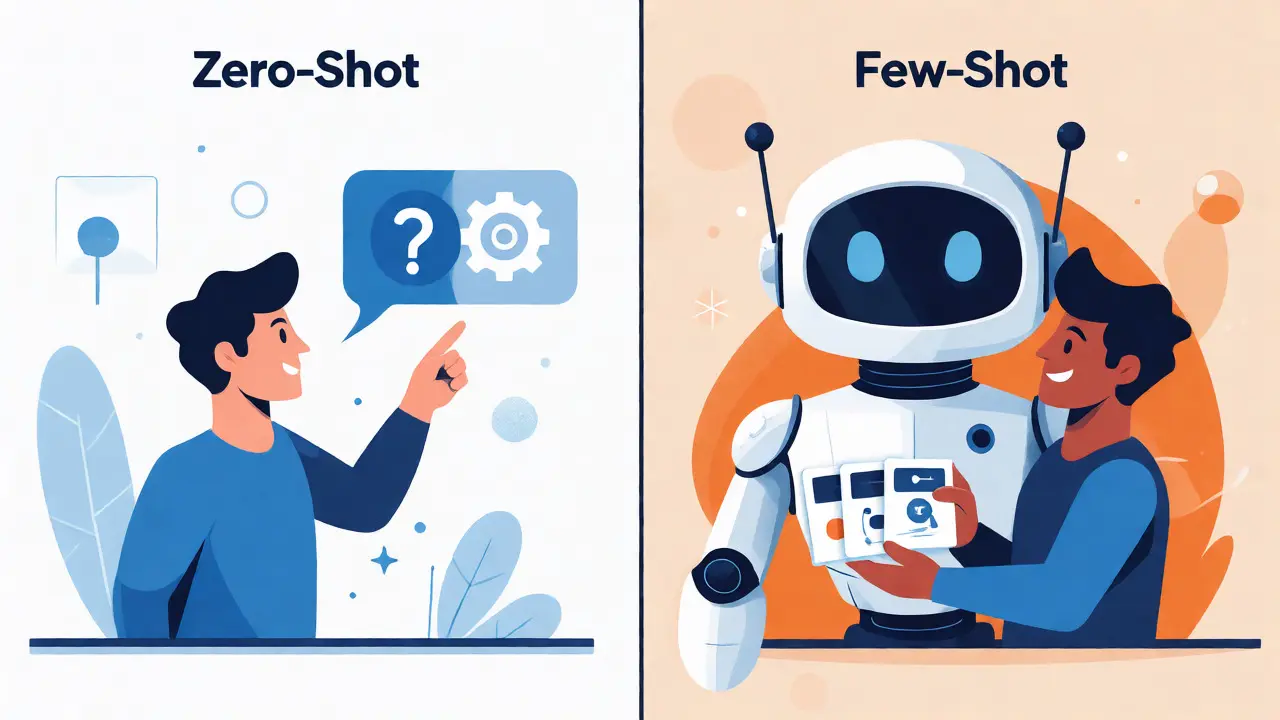
This is the core dilemma of modern AI deployment: Zero-Shot versus Few-Shot capabilities. It sounds technical, but it’s really about efficiency and accuracy. Zero-shot means asking the model to do something without showing it any prior examples. Few-shot means giving it a handful of examples (usually 2-10) to show it what you want. The difference in performance can be massive, depending on the task.
Let’s break down when you should rely on the model’s raw intelligence and when you need to hold its hand with examples. We’ll look at real data, specific use cases, and a decision framework you can actually use tomorrow.
What Is Zero-Shot Learning in LLMs?
Zero-shot learning is exactly what it sounds like: the model performs a task without having seen any specific examples of that task during the prompt. It relies entirely on its pre-training knowledge-the billions of words and patterns it absorbed during training-and its ability to follow instructions.
Think of it like hiring a brilliant intern who has read every book in the library but has never worked in your specific office. If you ask them to "summarize this email," they can probably do it because summarization is a common human activity they’ve seen everywhere. But if you ask them to "classify this ticket using our internal codes A-47 and B-92," they might struggle unless those codes are defined in the instruction itself.
The power of zero-shot lies in speed and simplicity. You don’t need to curate datasets. You don’t need to worry about example bias. You just write a clear instruction and hit enter. For many general tasks, this works surprisingly well. Studies show that models like Flan-T5 can achieve high precision even without examples, sometimes hitting over 90% accuracy in image classification tasks purely through pattern matching.
Why Few-Shot Prompting Changes the Game
If zero-shot is the brilliant intern, Few-shot learning is the senior mentor showing them exactly how the company does things. By providing a small set of input-output pairs-typically between 2 and 10 examples-you anchor the model’s behavior. This technique, often called "in-context learning," allows the model to adapt to specific formats, tones, or logical structures without any weight updates or fine-tuning.
Why does this work? Large Language Models are essentially pattern completion engines. When you provide examples, you’re not teaching the model new facts; you’re showing it the *pattern* of the response. If you want JSON output, show it two examples of JSON output. If you want a sarcastic tone, show it two sarcastic responses. The model picks up on these cues instantly.
The impact is measurable. In healthcare applications, using few-shot prompting helped organizations cut diagnostic tool development time by 40%. Why? Because instead of building a custom classifier from scratch, developers could just show the model five examples of rare disease symptoms and their diagnoses, and get immediate, usable results.
Performance Metrics: Does Adding Examples Really Help?
You might think adding examples always improves results. Not necessarily. Sometimes, bad examples confuse the model more than no examples help it. But generally, for complex or domain-specific tasks, few-shot outperforms zero-shot significantly.
Let’s look at some hard numbers. In evaluations of clinical and biomedical natural language processing tasks, models like Tk-Instruct showed varying degrees of success. With zero-shot, Tk-Instruct achieved an F1-score of 0.88 ± 0.01. That’s good. But for tasks requiring strict formatting or nuanced understanding, providing examples stabilized the output. Another study involving over 700,000 sentences found that while zero-shot models could reach 78.5% accuracy on finding intrinsic factors affecting drug exposure, adding targeted examples pushed consistency higher.
Here is a comparison of typical performance trends based on recent benchmarks:
| Metric/Aspect | Zero-Shot Capability | Few-Shot Capability |
|---|---|---|
| Setup Time | Minimal (Instruction only) | Moderate (Requires example curation) |
| Data Requirements | None | Small set (2-10 examples) |
| Accuracy on General Tasks | High (often >80%) | High (similar to Zero-Shot) |
| Accuracy on Niche/Domains | Degrades rapidly | Stable and High |
| Output Consistency | Variable (formatting errors common) | High (patterns enforced) |
| Cost per Query | Lower (fewer tokens) | Higher (more tokens for examples) |
When to Choose Zero-Shot: Speed and Simplicity
Use zero-shot when you need to move fast and the task is relatively standard. If you’re asking an LLM to translate text, summarize an article, or answer a factual question, the model already knows how to do these things. Adding examples adds token costs and latency without significant gains.
Consider these scenarios where zero-shot shines:
- Prototyping: You’re testing an idea and don’t have labeled data yet.
- General Knowledge Queries: Asking "Who was the first president of the US?" doesn’t need examples.
- Broad Classification: Sentiment analysis on social media posts often works well with just a clear definition of positive/negative.
- Creative Writing: Asking for a poem or a story outline rarely benefits from rigid examples.
The key here is tolerance for error. If the model outputs a summary that’s slightly too long or misses one minor detail, is that a dealbreaker? If not, stick with zero-shot. It keeps your prompts clean and your API bills lower.
When to Choose Few-Shot: Precision and Control
Few-shot becomes essential when the task is ambiguous, highly structured, or domain-specific. If you need the model to extract data into a specific JSON schema, or classify tickets using obscure internal codes, you must show it what those codes look like in practice.
Here is when you should definitely switch to few-shot:
- Strict Formatting: You need valid XML, JSON, or CSV output. Show the model two examples of valid output.
- Nuanced Tone: You want a brand voice that is "professional but witty." Abstract descriptions fail; examples succeed.
- Complex Logic: Tasks involving multi-step reasoning (like chain-of-thought) benefit from seeing the reasoning steps in previous examples.
- Low-Resource Domains: Legal, medical, or proprietary tech fields where the model hasn’t seen much training data.
A 2023 study highlighted that while zero-shot models can approach state-of-the-art performance for question-answering, they lag behind specialized models for relation extraction. Providing examples bridges this gap effectively, allowing generalist models to compete with specialist ones.

The Hidden Pitfalls of Example Selection
Not all examples are created equal. Bad examples can degrade performance more than no examples at all. This is known as "example sensitivity." If you pick examples that are outliers or contradictory, the model gets confused.
To avoid this, follow these rules:
- Variety: Ensure your examples cover edge cases. If you’re classifying emails, include a spam email, a sales pitch, and a personal note.
- Consistency: All examples must follow the exact same format. If one uses single quotes and another uses double quotes in JSON, the model will hesitate.
- Relevance: Don’t use generic examples for niche tasks. If you’re extracting financial data, use financial documents, not grocery lists.
- Order Matters: Some models perform better if the most relevant example is closest to the query. Experiment with ordering.
Remember, the goal isn’t to teach the model new facts (it likely already knows them), but to teach it the *behavior* you expect.
Building Your Decision Framework
How do you decide which path to take? Use this simple checklist before writing your prompt:
- Do I have labeled examples? If no, start with zero-shot.
- Is the task general or specific? General = Zero-shot. Specific/Niche = Few-shot.
- Is formatting critical? Yes = Few-shot. No = Zero-shot.
- Can I tolerate moderate errors? Yes = Zero-shot. No = Few-shot.
- Am I constrained by cost/latency? Tight constraints = Zero-shot (fewer tokens).
In enterprise settings, deploying open-source LLMs like Llama-3-8B-Instruct or Mistral-7B-Instruct locally often favors few-shot strategies. Since these models may have less broad pre-training than giant closed models, they rely heavily on in-context guidance to perform well on business-specific tasks.
Future Outlook: Where Are We Headed?
The line between zero-shot and few-shot is blurring. As models get larger and better trained, their zero-shot capabilities improve. GPT-4 and similar frontier models handle complex instructions so well that the need for explicit examples decreases for many tasks. However, for high-stakes applications in healthcare, finance, and law, the reliability provided by few-shot prompting remains crucial.
Researchers continue to explore automated example selection-algorithms that pick the best examples for a given query dynamically. This could eventually make the manual curation of examples obsolete, combining the speed of zero-shot with the precision of few-shot automatically.
For now, though, you are the engineer. Understanding when to provide context and when to trust the model’s intuition is a superpower in the age of AI.
What is the difference between zero-shot and few-shot learning?
Zero-shot learning asks the model to perform a task without any prior examples, relying on its pre-trained knowledge. Few-shot learning provides the model with a small number of examples (typically 2-10) within the prompt to demonstrate the desired output format or logic.
Does few-shot prompting always improve accuracy?
No. While few-shot prompting generally improves consistency and accuracy for complex or niche tasks, poorly chosen or inconsistent examples can confuse the model and degrade performance compared to a clear zero-shot instruction.
How many examples should I use for few-shot prompting?
Typically, 2 to 10 examples are sufficient. Using too many increases token costs and latency without significant gains. Start with 2-3 diverse examples and add more only if the model struggles with edge cases.
When should I use zero-shot prompting?
Use zero-shot for general tasks like summarization, translation, or fact retrieval, when speed is critical, or when you lack labeled examples. It is also suitable when moderate error tolerance exists.
Can zero-shot models match fine-tuned models?
For many tasks, yes. Recent studies show that large instruction-tuned models can approach the performance of state-of-the-art fine-tuned models in zero-shot scenarios, particularly for question-answering. However, for highly specialized domains, fine-tuning or few-shot prompting still holds an advantage.